Affiliate marketing is about to stop being a dashboard job. The next version is an agentic workflow: you hand an agent a campaign goal, the constraints, the product details, the audience target, the budget, and your approval rules, and it runs the repetitive machinery while you stay at the strategy and approval layer. Digital Applied reports that 73% of marketers are already using agentic AI in some form by end of 2026, with documented average ROAS improvements of 31% across paid media campaigns run by autonomous systems. This guide walks the full lifecycle of a beauty affiliate campaign, brief to wrap report, and shows where CreatorlandMCP becomes the data layer that makes the agent act on real creators instead of model guesses.
What Agentic Affiliate Marketing Actually Means
17 or more unique points of contact across a single 4-to-8-week brand-creator campaign (Influencer Hero, 2025): that coordination load is the problem agentic affiliate marketing is built to absorb. In this operating model, an AI agent autonomously plans, executes, and optimizes a creator affiliate program within human-set guardrails, instead of a human clicking through each step. Digital Applied describes the shift as humans setting objectives and guardrails rather than approving each action. The marketer owns strategy and exceptions; the agent owns discovery, outreach, triage, waterfalling, and reporting.
The distinction matters because the influencer-marketing workflow is unusually manual. Most of that 4-to-8-week cycle is search, email, and tracking overhead: the exact load an agent is built to absorb. The human does not disappear from the campaign; the human moves up the stack.
For this guide, the running example is a beauty brand launching an always-on TikTok and Instagram affiliate program for a new skincare or haircare product. The brand wants creators who already post GRWM routines, product reviews, “TikTok made me buy it” content, and affiliate-style shopping content. The goal is to recruit a first wave, give them an offer and affiliate terms, manage replies, and expand automatically based on performance.
Beauty Affiliate Is the Best First Use Case for Agents
Beauty affiliate campaigns are the strongest proving ground for agentic operations because the category runs on high creator volume, dense affiliate behavior, and clear performance signals. Affiliate sales already make up 82% to 84% of TikTok Shop GMV in top categories (OddDuck Marketing Group, 2025), and 73% of active TikTok Shop creators are affiliate creators as of late 2025 (Social Commerce Club, 2025). The supply of beauty-affiliate-relevant creators is enormous, which is exactly the condition where manual sourcing breaks down.
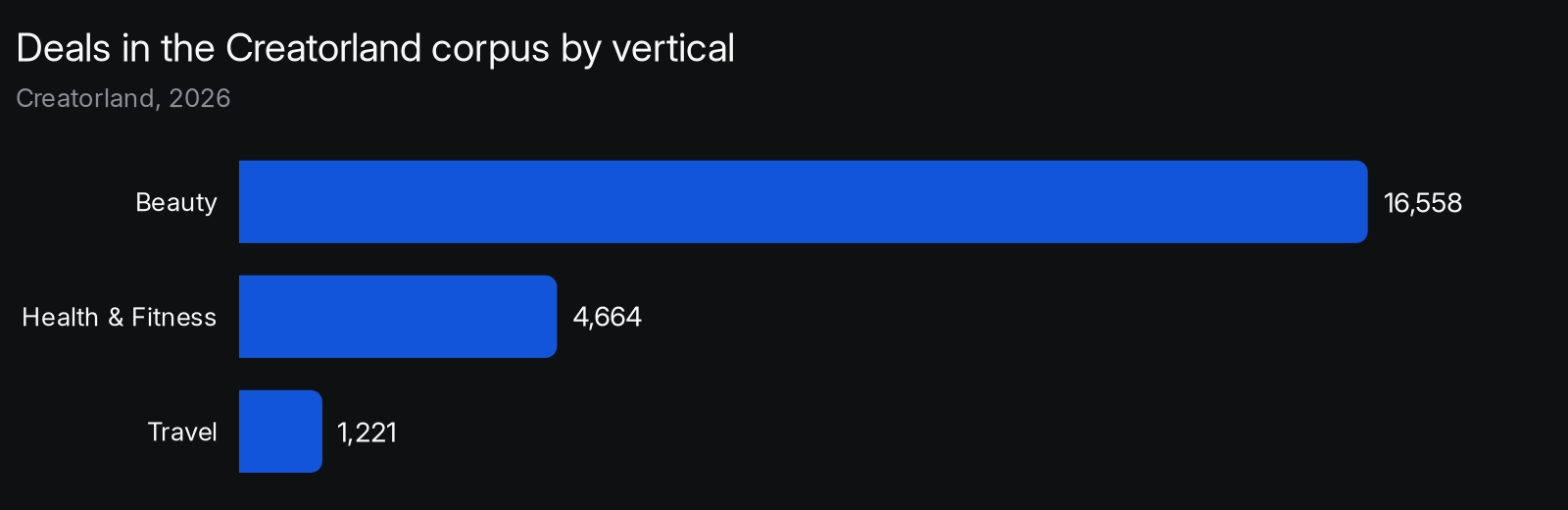
It is also the condition where an agent’s discovery advantage compounds. Beauty has the deepest deal data in Creatorland’s corpus: the beauty vertical carries 16,558 deals, far ahead of health and fitness at 4,664 and travel at 1,221 (Creatorland, 2026). More closed deals means tighter rate bands, more affiliation history to verify against, and more lookalike seeds to expand from.
Finding the right creators is where this urgency hits hardest on the brand side: 30% of marketers cite it as their single biggest challenge, ranking above campaign measurement and contract management combined (Influencer Marketing Hub, 2025). An agent that searches, verifies, and ranks against real closed-deal data, rather than a scraped public profile list, goes straight at that bottleneck.
CreatorlandMCP Is the Agent-Native Data Layer
CreatorlandMCP is a remote Model Context Protocol server that lets an AI agent query Creatorland’s first-party creator, brand, deal, and social-post data directly, instead of guessing from model memory. It plugs into Claude, Cursor, Perplexity, Claude Cowork, or any agent harness a marketing team already runs. The data layer covers a discovery pool of over 2.6 million creators, 800K+ indexed posts, and a brand catalog with thousands of canonical brands and verified creator-brand affiliations (Creatorland, 2026).
The reason this matters is hallucination. When Creatorland ran 60 influencer-marketing prompts through Claude alone, 57% of answers carried hallucination risk; Claude with the MCP returned zero hallucination-risk answers across all 60 (Creatorland, 2026). On casting prompts specifically, Claude alone fabricated creator names in 17 of 20 cases, while the MCP verified all 20 against the live corpus.
The MCP exposes three core tools the agent strings together across the campaign:
- search-creators: finds and ranks creators from a structured brief or a lookalike seed, filtering on category, platform, audience, deal type, geo, follower tier, prior brand affiliation, and freshness.
- get-creator-profile: pulls a unified profile from a handle, email, or Creatorland ID, including platform mix, engagement, audience geography, interest tags, brand partnership history, and identity-resolution status.
- query-market-intelligence: returns p25, median, and p75 rate bands by vertical, platform, deal type, and tier from real closed deals, with provenance metadata and a minimum-N privacy floor so no individual deal is reconstructible.
CreatorlandMCP is the creator-economy intelligence layer, not a replacement for your whole stack. It supplies discovery, identity, affiliations, and pricing; the agent composes it with the email tool, ecommerce system, and affiliate platform you already run.
Step 1: The Human Sets the Campaign Objective
6 core inputs define this layer: the product, the target customer, the creator criteria, prohibited competitor conflicts, the budget, and the commission structure. Human involvement concentrates here, at the strategy and approval layer. The marketer also sets product seeding rules, approval rules, and escalation thresholds. Everything downstream is the agent executing against this contract.
For the beauty brand, that looks like: a new haircare serum, target customer of 18-to-34 women in the US, creators who post haircare and GRWM content with 30K+ followers on TikTok or Instagram, no creators currently working with two named competitor brands, a $40,000 first-wave budget, a gifted-plus-affiliate offer at a set commission, and a rule that any per-creator paid offer above $1,500 needs human sign-off.
This is human-in-the-loop approval: the human owns the objective and the exception thresholds, and the agent operates freely below them. Get this layer right and the rest of the campaign runs with minimal touchpoints. Get it vague and the agent escalates constantly, which defeats the point.
Step 2: The Agent Turns the Input Into a Structured Brief
8 fields get extracted from a messy input, whether that input is a call transcript, a Slack message, or a campaign doc, and structured into the exact format search-creators expects: platform, vertical, audience, content style, creator tier, geography, brand-safety rules, and deal type.
This is the unglamorous step that legacy workflows skip, which is why so many campaigns start from a half-formed brief. The agent forces structure: TikTok and Instagram, beauty/haircare vertical, US audience skewing 18 to 34, GRWM and product-review content style, 30K to 250K follower tier, gifted-plus-affiliate deal type, two excluded competitor brands.
A clean structured brief is what makes agentic creator discovery repeatable. The same brief object drives discovery, enrichment filtering, and the final wrap report, so the campaign stays internally consistent from intake to results.
Step 3: The Agent Discovers and Ranks Creators
150 is the maximum number of ranked creators a single search-creators call can return, and that ceiling defines the scope of the longlist the agent builds from the structured brief, scoring each creator on relevance instead of raw follower count. For the beauty campaign, it pulls creators with haircare and GRWM content history, affiliate-style posting patterns, strong engagement, and relevant prior brand affiliations, ranked by fit to the brief.
This is where grounding pays off. search-creators supports brief mode and lookalike mode, returns up to 150 results, and filters on platform, niche, country, city, follower range, interests, hashtags, brand affinities, verification, and engagement rate (Creatorland, 2026). The agent can seed a lookalike search from a creator the brand already loves and get a tiered list of the same vibe in different price bands.
The contrast with the legacy motion is stark. AI-powered creator discovery has been shown to cut search time by about 85% versus manual sourcing (Influencer Marketing Hub, 2025). The agent is not just faster; it is searching against creator-volunteered data with freshness signals, not a scraped rolodex that returns the same overexposed names.
Step 4: The Agent Enriches and Verifies the Shortlist
72% of brands report they struggle to identify fake engagement when evaluating creators (Influencer Marketing Hub, 2025), which is exactly the problem this step is built to close. The agent calls get-creator-profile on every longlisted creator to verify identity, platform mix, follower counts, engagement, audience fit, brand history, interests, and freshness before anyone gets contacted. It removes poor fits, stale profiles, creators with conflicting brand relationships, and anyone outside the budget or audience target.
This step exists because raw follower count is an unreliable signal. Brands waste an estimated $4.6 billion per year on partnerships compromised by fake followers (industry analysis, 2025), and verification against first-party data is the highest-use filter in the funnel.
The conflict check is the part beauty teams underestimate. get-creator-profile surfaces brand partnership history, so the agent can automatically drop any creator currently affiliated with the two excluded competitor brands. Creator-brand affiliation data is the record of which creators have actually worked with which brands, verified through Creatorland’s profile and identity-resolution layer rather than inferred. That is the data legacy CRMs cannot produce because their creators never opted in.
Step 5: The Agent Benchmarks Pricing and Offer Structure
The agent calls query-market-intelligence to pull real rate bands for beauty creators by platform, deal type, and tier, then recommends the offer shape. It returns p25, median, and p75 bands from actual closed deals, so the agent prices to market instead of guessing. A beauty sponsored-post example in the corpus showed a median of $250 from 781 deals over 90 days (Creatorland, 2026).
Grounding the offer is what keeps the campaign credible and on budget. In a 60-prompt hallucination study, Claude alone fabricated or estimated unsourced rate numbers in 9 of 20 rate prompts; with the Creatorland Data MCP it produced zero fabricated rates across all 20 (Creatorland, 2026). For a brand setting commission and seeding terms across dozens of creators, fabricated pricing is how you either overpay or send offers that creators ignore.
With real bands in hand, the agent recommends whether the campaign runs pure affiliate, gifted-plus-affiliate, paid trial-plus-affiliate, or a hybrid. Beauty leans toward gifted-plus-affiliate at the volume end because the unit economics favor it, and the agent anchors each individual offer to the creator’s tier so the pitch lands market-credible.
Step 6: The Agent Prepares Personalized Outreach
The agent writes creator-specific outreach using real context pulled from the Creatorland Data MCP: the creator’s recent content themes, relevant brand history, platform strengths, and a concrete reason they fit the product. It interoperates with Gmail or another email tool to draft or send, subject to whatever human approval rule the team set at the start of the workflow.
Personalization at this layer is not cosmetic. A real, recent reference, naming the creator’s last haircare review or their GRWM series, is what separates a reply from a deleted cold email. Customers engaged through AI personalization are 2.3x more likely to purchase, Digital Applied reports, and the same dynamic applies to creator recruitment: relevance drives response.
The boundary matters here. The Creatorland Data MCP supplies the context that makes the outreach personal; the email tool sends it. The agent orchestrates between them, and the human approval rule decides whether messages go out automatically or queue for a quick review first.
Step 7: The Agent Manages Replies and Next Actions
The agent triages every reply into interested, declined, questions, negotiation, no response, and out of office, then drafts the next action for each. Human review is reserved for exceptions: sensitive responses, negotiations outside the guardrails, or any offer above the budget threshold the team set at campaign kickoff.
This solves a quiet revenue leak. Roughly 25% of brand-deal emails surfaced inside creator inboxes go unanswered (Creatorland, 2026), and speed cuts both ways: responding to an inbound within an hour makes conversion roughly 7 times more likely (Harvard Business Review). An agent triaging replies in real time keeps interested creators from going cold while a human is in meetings.
The agent flags, it does not overstep. A creator pushing for a rate above the approval threshold gets routed to the human with the market band attached, so the decision takes seconds. Everything inside the guardrails, a yes, a clarifying question, a standard counter, the agent handles and logs.
Step 8: The Agent Waterfalls the Campaign
3 to 5 simultaneous brand deals is all most creators can handle before quality suffers (creator-economy analysis, 2025), which is exactly why a waterfall matters: the agent paces recruitment to actual acceptance capacity instead of flooding the market and burning the list. It reaches tier one first, and on no-reply or decline, releases budget to the next tier automatically, rather than waiting for a human to notice a thin pipeline a week later.
Throughout, the agent maintains a live campaign tracker: every conversation by status, next touch, and age. It ages open conversations, suppresses opt-outs, avoids duplicate outreach, and keeps cumulative spend inside the $40,000 cap. A 45-day cooldown between the same brand and creator prevents the campaign from re-contacting someone who recently passed (Creatorland, 2026).
This is the step that makes the program always-on rather than a one-time blast. The waterfall paces recruitment continuously to real acceptance capacity, turning a single campaign into a self-replenishing pipeline.
Step 9: The Agent Hands Off Fulfillment and Affiliate Setup
This step is interoperability, not a native Creatorland MCP function. Once a creator accepts, the agent composes the Creatorland Data MCP with the brand’s other systems to trigger product seeding, create affiliate links, log the creator, and update campaign status. The MCP confirms who the creator is; the other tools do the fulfillment.
In practice the agent strings the systems together: Shopify or the ecommerce platform handles the product seed and the order, the affiliate platform mints the tracking link and sets commission terms, and a sheet, Airtable, HubSpot, or an internal tracker logs the creator and stage. The Creatorland Data MCP never sends the email, creates the order, or runs the payout itself; it supplies the verified creator identity and affiliation context the other systems act on.
This composition is the whole point of an MCP architecture. The agent is the orchestrator, the Creatorland Data MCP is the creator-economy data layer, and the rest of the stack stays exactly what it already is. No rip-and-replace, no migration project required.
Step 10: The Agent Monitors Performance and Produces the Wrap Report
The agent rolls the campaign into an executive-ready wrap report: outreach volume, reply rates, accepted creators, projected and actual spend, the pricing bands used, active creators, content status, and next-step recommendations. It also flags which creator segments to scale, closing the loop back to the waterfall.
This matters because measurement is the channel’s persistent weak spot. 53% of marketers struggle to determine the exact ROI of their influencer programs (Linqia, 2025), largely because the data lives in disconnected tools. An agent that already holds the structured brief, the verified shortlist, the real rate bands, and the live campaign tracker can produce attribution that legacy spreadsheet workflows cannot assemble by hand.
Budget reallocation does not wait for the post-mortem. The wrap report feeds directly into the next wave: the agent recommends scaling the segments that converted and trimming the ones that did not, then the human approves the next budget release. The campaign loop closes, and the next one starts with better data than the last.
Map Who Owns What in an Agentic Campaign
In a working agentic campaign, responsibility splits cleanly across three owners: the human owns judgment, the agent owns operations, and the connected systems own delivery. Getting this map right is the difference between a campaign that runs with minimal human involvement and an agent that constantly stalls for input.
The human owns the objective, the budget, the creative and legal constraints, the approval thresholds, and the final call on every exception. The agent owns brief structuring, discovery, enrichment, rate benchmarking, outreach drafts, reply triage, waterfalling, tracker updates, and reporting. The connected systems own email delivery, affiliate links, product fulfillment, commission tracking, and analytics.
The legacy model collapses all three roles onto the human. A marketer running an influencer CRM searches, filters, exports, emails, follows up, benchmarks rates by hand, and builds the report manually. The agentic model leaves the human only the decisions that actually require judgment.
| Campaign stage | Agent action | Creatorland MCP role | External system | Human checkpoint |
|---|---|---|---|---|
| Brief intake | Structures the brief from a transcript or doc | Defines the searchable fields | Doc or Slack source | Approve the brief |
| Discovery | Builds and ranks a longlist | search-creators returns ranked matches | None | None below guardrail |
| Verification | Filters fakes, conflicts, stale profiles | get-creator-profile verifies each | None | None below guardrail |
| Pricing | Recommends offer shape and rate | query-market-intelligence returns bands | None | Approve offers over threshold |
| Outreach | Drafts and sends personalized messages | Supplies creator context | Gmail or email tool | Approve send rule |
| Fulfillment | Triggers seeding and affiliate links | Confirms verified identity | Shopify, affiliate platform | None below guardrail |
The Marketer Moves Up the Stack, Not Out of the Job
17 is the number that explains why the shift is already underway: a typical brand-creator campaign requires 17 or more unique points of contact across a 4 to 8 week cycle, and that coordination load is what agents are built to absorb. Humans define the strategy, the constraints, and the approvals. Agents execute the repetitive campaign machinery, the search, the verification, the benchmarking, the triage, the waterfall, and the reporting that used to eat the week.
The reason this is operational reality and not a demo is the data layer. An agent without grounding fabricates creators and rate numbers, which is worse than useless for a campaign with real budget attached. The Creatorland Data MCP gives the agent verified creators, real brand affiliations, and market-anchored pricing from a corpus of 2.6 million creators and real closed deals, so it acts on facts instead of model guesses. That is the difference between an agent you can hand a $40,000 budget and a chatbot you have to double-check.
The beauty brand in this guide never replaced its marketer. It freed her from the 17-touchpoint grind so she could spend her time on the calls the agent escalated and the strategy the agent could not invent.
How the Category Stacks Up for Agentic Workflows
3 dimensions decide which platform actually works for agentic creator campaigns: whether an AI agent can query the data directly, whether the creator data is first-party, and whether real pricing is available to ground offers. Brands evaluating this category are really choosing between scraped third-party databases, opt-in CRMs, and an agent-native data layer.
| Platform | Agent-native access | Creator data source | Rate intelligence | Entry pricing |
|---|---|---|---|---|
| Creatorland MCP | Native MCP server for any agent harness | First-party, creator-OAuth | p25/median/p75 from real deals | $199/mo pilot |
| CreatorIQ | No public MCP; dashboard-first | Scraped, ~20M profiles | Filter analytics, no deal bands | $35K to $200K/yr |
| GRIN | No public MCP; Gia AI in-app | 190M+ opt-in/authenticated | CRM features, limited bands | $25K to $200K+/yr |
| Aspire | No public MCP; dashboard-first | 1M+ marketplace creators | In-platform, no deal corpus | $27,600 to $60K/yr |
| Modash | No public MCP; filter search | 350M+ public profiles | Discovery-only, no payments | $199 to $499/mo |
The legacy CRMs are built for a human to operate a dashboard, and their data is largely scraped, which is why filter searches “frequently produce irrelevant results” (Modash, 2025). CreatorlandMCP is the row built for an agent to call directly, with first-party data and real rate bands behind every answer.
Frequently Asked Questions
What is agentic affiliate marketing?
Agentic affiliate marketing is a model where an AI agent autonomously runs a creator affiliate campaign, discovery through reporting, inside human-set guardrails. The human sets the objective, budget, and approval rules; the agent executes the repetitive work. Digital Applied reports 73% of marketers are using agentic AI in some form by end of 2026.
Can AI run an affiliate creator campaign by itself?
Mostly, below the guardrails you set. An agent can structure the brief, discover and verify creators, benchmark rates, draft outreach, triage replies, waterfall the campaign, and produce the wrap report without human touchpoints. It still escalates exceptions: offers over budget, sensitive replies, and final strategic calls.
Where should humans stay involved?
Humans own the objective, budget, creative and legal constraints, approval thresholds, and every exception. The agent operates freely below those thresholds and routes anything above them to a person with the context attached. Concentrating human involvement at the strategy and approval layer is what keeps the campaign both safe and low-touch.
How does CreatorlandMCP reduce hallucinations?
It grounds the agent in real corpus data instead of model memory. When Creatorland ran 60 influencer-marketing prompts through Claude alone, 57% carried hallucination risk; with the MCP, zero did across all 60 (Creatorland, 2026). On casting prompts, Claude alone invented creator names in 17 of 20 cases while the MCP verified 20 of 20.
How does CreatorlandMCP work with Shopify, Gmail, or affiliate platforms?
Through interoperability, not replacement. CreatorlandMCP supplies verified creator identity, affiliations, and pricing; the agent composes that with Gmail for outreach, Shopify for product seeding, and an affiliate platform for links and commissions. CreatorlandMCP never sends email, creates orders, or runs payouts itself.
What makes beauty affiliate campaigns a good use case for agents?
High creator volume, dense affiliate behavior, and clear performance signals. Affiliate sales make up 82% to 84% of TikTok Shop GMV in top categories (OddDuck Marketing Group, 2025), and beauty carries the deepest deal data in the corpus at 16,558 deals (Creatorland, 2026), giving agents tighter rate bands and more affiliation history to verify against.
How is this different from an influencer CRM?
A CRM makes a human search, filter, export, email, follow up, and report manually inside a dashboard. The agentic model inverts that: the human sets strategy and approves exceptions, and the agent does the operational work, querying CreatorlandMCP directly instead of a person clicking through filters.
How CreatorlandMCP Grounds Agentic Campaigns in Real Creator Data
40+ pre-built workflow skills ship with CreatorlandMCP, covering casting, outreach, rate benchmarking, and wrap reporting, and every one of them runs on real creators, real affiliations, and real pricing rather than hallucinated stand-ins. CreatorlandMCP is a remote Model Context Protocol server that plugs Creatorland’s first-party data layer into Claude, Cursor, Perplexity, Claude Cowork, or any agent harness your team already uses. The three core tools, search-creators, get-creator-profile, and query-market-intelligence, map directly onto discovery, verification, and pricing in the campaign workflow.
The data behind it is the differentiator: a discovery pool of 2.6 million creators, 800K+ indexed posts, and verified creator-brand affiliations, all built on data creators OAuth into and have a stake in keeping accurate, with privacy floors against individual-record reconstruction. In Creatorland’s own 60-prompt study, that grounding cut hallucination risk from 57% against Claude alone to zero across all 60 prompts (Creatorland, 60-Prompt Influencer Marketing Hallucination Study, 2026). The early-adopter program runs through Summer 2026 at $199 per month with dedicated onboarding, built for brands and agencies of every size, not just F500.