Adoption of autonomous AI agents inside marketing teams roughly doubled in 15 months, and that jump is the clearest signal yet that agentic workflows have moved from experiment to operating standard.
The creator economy reached $205.25 billion in 2024 and is projected to grow at a 23.3% compound annual growth rate to over $1.34 trillion by 2033 (Grand View Research, 2024), making the efficiency gains from agentic workflows material to every brand operating in this space. For agencies, this is not a curiosity, it is a margin question with only a few possible answers. This piece maps where adoption stands, why the economics force the issue, and how Creatorland’s MCP slots into the agentic stacks that brands and agencies are already building.
Autonomous Agents in Marketing Teams Nearly Tripled in 15 Months
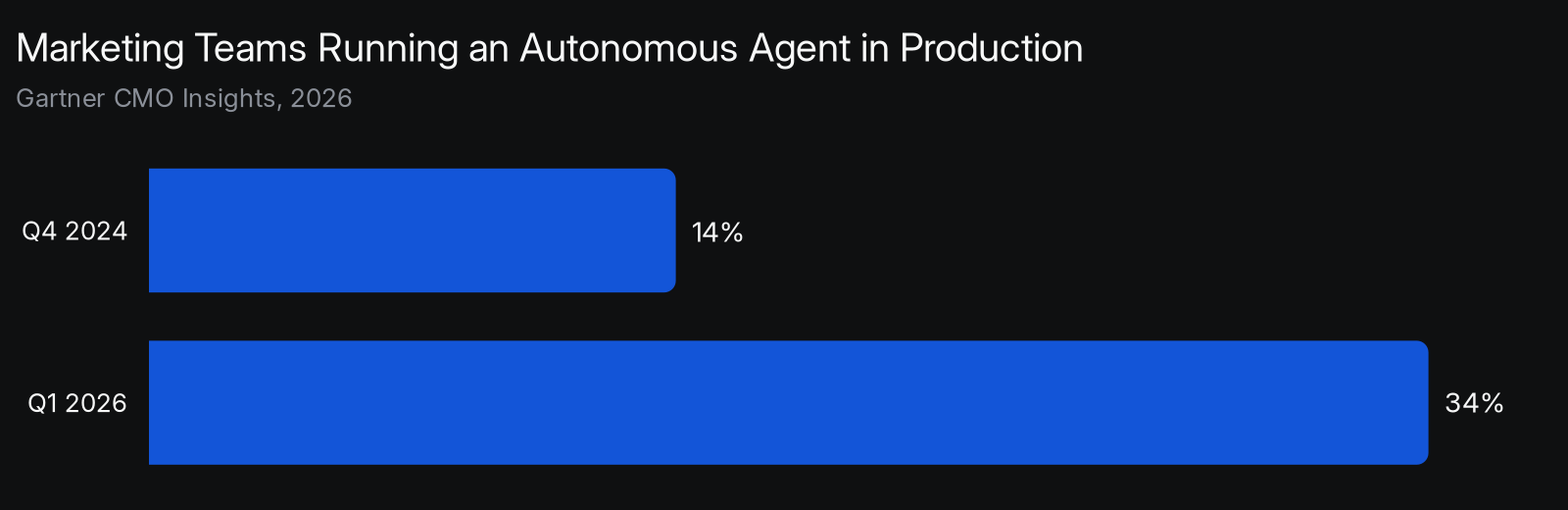
The share of enterprise marketing teams running at least one autonomous agent in production grew from 14% in Q4 2024 to 34% in Q1 2026, a roughly 2.4x increase in just over a year (Gartner CMO Insights, 2026). That curve tracks a structural shift: the conversation in enterprise marketing has moved from simple automation to autonomous, intelligent systems that set their own task sequences in pursuit of a stated goal.
The distinction matters. Task-based automation runs a fixed sequence: trigger fires, action executes, done. An agentic workflow hands the system an outcome, not a script, and it decides the steps independently.
The reason this curve keeps climbing is structural, not faddish. Once a meaningful slice of the market proves an agent can do the work, the rest of the market cannot afford to keep doing it by hand.
Agencies Have Only Three Levers, and Agents Pull All Three
An agency has exactly three ways to grow margin: raise prices, cut costs, or serve more clients with the headcount it already has. Agentic AI is the first tool in years that pulls all three at once, which is why adoption inside services businesses is following the same steep curve as the broader market.
Raising prices is hard in a competitive bid environment. Cutting headcount caps capacity. The third lever, expanding what a fixed team can deliver, is where agents change the math: the same account team handles more clients because the agent absorbs the manual hours. Independent influencer-marketing shops running 5 to 50 people feel this most acutely, since every billable hour spent on manual sourcing is an hour not spent on strategy a client will pay a premium for.
There is also a competitive ratchet. The moment a top competitor starts winning pitches faster and cheaper because an agent is doing the grunt work, every other shop in the category has to follow or lose the account. That dynamic is precisely why efficiency gains do not plateau; they compound.
Influencer Marketing Is the Most Manual Workflow Agents Can Fix
A typical brand-creator campaign requires 17 or more unique points of contact across a 4 to 8 week cycle (Influencer Hero, 2025), making influencer marketing one of the most labor-intensive workflows an agency runs and the highest-value target for agentic automation.
Global influencer marketing reached $32.55 billion in 2025, up 35.6% year-over-year from $24 billion in 2024 (Influencer Marketing Hub, 2025), and the market is projected to reach $40.51 billion in 2026 (Mordor Intelligence, 2026), confirming that the efficiency gains from automation compound across a multi-billion-dollar spend category. The front of that funnel, finding and vetting the right creators, is the heaviest lift of all.
It is also the part agencies most want to offload.
66.3% of brands run their influencer programs entirely in-house, and the single most commonly outsourced function is creator discovery and vetting (19.44%), ahead of content production (15.28%) (Influencer Marketing Hub, 2025), a direct signal that finding and vetting creators is the hardest part to staff internally. Influencer Marketing Hub’s 2025 benchmark found that 30% of marketers name “finding the right creators” as their single biggest challenge, ranking above campaign measurement and contract management combined. When the hardest, most time-consuming step is also the most error-prone, it is the obvious first place to point an agent.
The catch is that an agent is only as good as the data it can call.
72% of brands report they struggle to identify fake engagement when evaluating creators, which is why raw follower count is an unreliable vetting signal (Influencer Marketing Hub, 2025), and brands waste an estimated $4.6 billion per year on influencer partnerships compromised by fake followers (Industry analysis, 2025). A language model left to its own priors will confidently invent creators, follower counts, and rate ranges that do not exist. The fix is not a smarter model, it is a live tool the agent can query for ground truth.
A National Geographic Casting Test Ran 60x Faster Through the MCP
The Creatorland MCP returned 69 high-confidence creator matches for a National Geographic campaign in about 5 minutes: a 60x speedup against the roughly 5 hours the same task takes in Influential’s existing Captiv8 workflow, and their team described that as a good day, with the task sometimes running 5 to 8 hours or longer.
The brief was not simple. Influential asked Creatorland to find creators across a stack of highly specific targets, the kind of multi-dimensional search that breaks filter-based tools:
- Documentary and educational creators (history, science, explainer, “today I learned” style)
- TV and streaming recommendation creators (“what to watch” content)
- Family-friendly TV recommendation and entertainment creators
- NYC natives, not transplants, with strong storytelling and community POVs
- Spanish-language creators, especially Chilean or Latin American voices
- Pet and animal creators for reaction-style content
- Tom Hiddleston fan and fandom accounts
- Creators open to recurring multi-title partnerships across several Nat Geo releases
- Follower count between 100K and 750K
Influential is not a small player struggling for lack of tooling. The company bought Captiv8 for a reported $100M largely for its technology, and insiders still rely primarily on manual search and discovery for client casting. The MCP returned 69 creators matching across all of those criteria in the time it takes to read this section.
That is the agentic workflow working as designed: one goal in, a planned multi-step search executed against live first-party data, a ranked shortlist out, no human running queries one filter at a time. The skill behind it, “find creators from a brief,” is one of 40-plus pre-built workflows that ship with the MCP, alongside “cast across markets” for multi-country concepts and “find lookalikes” for seeding off a creator you already love.
The MCP Cut Hallucination Risk From 57% to 0% Against Claude Alone
Across 60 identical influencer marketing prompts, hallucination risk dropped from 57% with Claude alone to 0% with Claude connected to the Creatorland MCP, a gap that separates an agent that guesses from an agent that knows, and the core reason a first-party data tool belongs in an agentic stack.
The failure pattern was consistent across prompt types. On casting prompts like “find me 10 creators for X,” Claude alone invented names in 17 of 20 cases; with the MCP, zero invented names, every creator carrying verified followers, geography, and brand affiliations. On rate prompts, Claude alone fabricated dollar ranges in 9 of 20 cases; with the MCP, zero fabricated, every figure backed by real medians, percentiles, and deal counts.
| Prompt category | Claude alone | Claude + Creatorland MCP |
|---|---|---|
| Casting (“find me 10 creators for X”) | 17 of 20 invented names | 0 invented; verified followers, geo, affiliations |
| Rate intelligence (“going rate for...”) | 9 of 20 fabricated ranges | 0 fabricated; real medians, percentiles, deal counts |
| Competitive intel (“works with X not Y”) | 0 of 5 answerable; no data to filter | 5 of 5 answerable; brand-affiliation graph filtering |
| Time-aware (“what changed since X date?”) | 0 of 6 answerable; no timestamps | 6 of 6 answerable; date-windowed corpus queries |
| Data behind the answer | Model priors only | 25,591 brands; 93,524 deals; 46,671 creators referenced |
The competitive and time-aware rows are the ones a model can never fake. “Find creators working with a competitor brand but not ours” and “what changed in this vertical since last quarter” are unanswerable from model priors alone, because the answers live in a graph of real, dated, closed deals. The MCP answered all of them, drawing on its query-market-intelligence and search-creators tool calls, while Claude alone answered none. That is the difference between a clever autocomplete and an agent you can put in front of a client.
The Margin Case Is Decided, Not Debated
86% of US marketers at larger firms plan to work with influencers in 2025, and about 63.8% of brands globally have concrete plans to partner with creators this year (Influencer Marketing Hub, 2025), putting influencer marketing in the mainstream of the marketing mix and making the adoption question moot.
80% of brands maintained or increased their influencer marketing budgets in 2025, with 47% raising budgets by 11% or more (Influencer Marketing Hub, 2025), a sign the channel is consolidating rather than retreating and that agencies adopting agentic workflows will capture disproportionate share of that growing spend. When influencer casting runs 60x faster through a live data tool, the agency that holds out is not being cautious; it is leaving margin on the table while its competitors take the account.
The piece that decides whether an agentic influencer workflow is a demo or a deliverable is the data layer underneath it. An agent that hallucinates on creator names and rates is a liability in front of a client; an agent grounded in first-party creator data is the thing that wins the pitch.
The shift from task-doer to strategic thinker only happens when the agent can be trusted to plan and execute without a human checking every name it returns.
How Creatorland Compares to the Tools Agencies Already Run
Creatorland’s MCP is the only entry in this category that exposes a remote, agent-callable server to Claude, Cursor, Perplexity, and 10 other AI tools directly, while legacy CRMs like CreatorIQ and GRIN were built for a human clicking through a dashboard. The dimensions that decide fit are how the tool exposes itself to an agent harness, what its data is built on, and the entry price for a mid-market shop.
| Tool | Agent-callable interface | Data foundation | Entry pricing |
|---|---|---|---|
| Creatorland MCP | Remote MCP server callable from Claude, Cursor, Perplexity, and 11 AI tools | First-party, creator-OAuth’d graph | $199/month pilot |
| CreatorIQ | No public MCP; platform UI and API | Scraped 20M+ creator profiles | $35,000 to $200,000/year |
| GRIN | No public MCP; platform UI | Authenticated and opt-in creators | $25,000 to $200,000+/year |
| Aspire | No public MCP; platform UI | 1M+ marketplace creators | $27,600 to $60,000/year |
The legacy CRMs are powerful platforms, but they were built for humans navigating a UI, not for agents stringing tool calls together. Their scraped data is also the same foundation that lets a model hallucinate a creator’s brand history or rate.
49% of marketers are now working with specialist influencer agencies, up from 28%, while in-house influencer management has dropped to 23% (Linqia, 2026). Mid-market and independent agencies are consolidating creator-marketing workload and competing on efficiency and data access, which is exactly where the MCP’s price point ($199 a month versus $35,000 to $200,000 a year for legacy CRMs) and agent-native design create the sharpest advantage.
Frequently Asked Questions
How is an agentic influencer workflow different from the automation agencies already use?
Traditional automation runs a fixed sequence you script in advance; an agentic workflow takes a goal and plans the steps itself. The Smarketers frames the difference as a train on a fixed track versus a self-driving car: one cannot deviate from its path, the other chooses the route. For casting, that means handing the agent a brief instead of running each filter by hand.
Why does hallucination risk matter so much for agency work?
Because a fabricated creator name or invented rate range goes straight to a client and destroys trust. In testing, Claude alone hallucinated on 57% of influencer marketing prompts; connected to the Creatorland MCP, that dropped to 0%. An agent you cannot trust in front of a client is not a deliverable, it is a liability.
Can the MCP actually plug into the tools our team already uses?
Yes. The Creatorland MCP is a remote Model Context Protocol server that connects to 11 AI tools including Claude, Claude Cowork, Cursor, and Perplexity. Claude and Cowork users install the full plugin and skill catalog with a single command, and the first tool call triggers OAuth, so there is no manual API key management.
What kind of creator searches can the MCP actually handle?
Multi-dimensional briefs that break filter-based tools. In the Influential test, the MCP matched 69 creators across documentary style, language, geography, fandom, follower tier, and willingness to do recurring deals, all at once. The search-creators tool accepts a structured brief or a lookalike seed and returns a ranked shortlist with audience data and brand-affiliation history.
Does the MCP help with pricing, or only discovery?
Both. The query-market-intelligence tool returns p25, median, and p75 rate bands derived from real closed deals, scoped to vertical, platform, deal type, and follower tier. Pre-built skills like “price a single deal” and “build a negotiation memo” run that data inside the agent, so a strategist gets a defensible number in seconds instead of guessing.
How fast is the actual time saving for an agency team?
In the Influential test, a casting task their team described as 5 to 8 hours ran in about 5 minutes through the MCP, a 60x speedup. That returned time is exactly the capacity an agency converts into serving more clients with the same headcount, which is the margin lever agents pull hardest.
Is this only worth it for enterprise agencies?
No, and that is the point. The legacy creator CRMs run $25,000 to $200,000 a year, out of reach for most mid-market and independent shops. The MCP runs at $199/month pilot pricing, built so a 5-to-50-person agency can put an agentic discovery workflow into production without an enterprise contract.
How Creatorland’s MCP Slots Into the Agentic Stack Agencies Are Building
The Creatorland Data MCP is a remote Model Context Protocol server giving any agent direct, callable access to a first-party creator graph of over 2.6 million creators, 800K+ indexed posts, and a brand catalog of thousands of canonical brands and verified affiliations, all OAuth’d by creators who have a stake in keeping it accurate. That first-party provenance is the differentiator: where scraped databases go stale the moment a creator changes rates or partners, this graph updates because creators control it.
Three direct tool calls do the work. search-creators turns a brief or a lookalike seed into a ranked shortlist, get-creator-profile returns verified social presence and brand history for any handle, and query-market-intelligence returns real rate bands from closed deals with a privacy floor that prevents any individual deal from being reconstructed. Around those sit 40+ pre-built skills spanning casting, outreach, pricing, market intel, and diligence, so a marketer can say “find creators from a brief” or “build a rate card” and the agent runs the full workflow. Pilot pricing runs through Summer 2026 at $199 per month, with an early-adopter program offering 50% off the standard $250 rate plus dedicated onboarding, sized for agencies of every scale rather than F500 budgets alone.