Influencer marketing spend in the US hit $10.52 billion in 2025 and is projected to reach $13.7 billion by 2027 (eMarketer, March 2025), yet more than half of the marketers writing those checks cannot tell you what the money actually returned. That is the gap this guide closes. By the end, a brand or agency team will have a repeatable framework for proving influencer impact across the full customer journey, not just last-click sales, and for using that proof to win bigger budgets next quarter.
Most Brands Are Scaling a Channel They Cannot Read
53% of marketers struggle to determine the exact ROI of their influencer programs (Linqia, 2025), which means more than half of the spend in this channel is flying without instruments. The money is going up and the measurement is not keeping pace.
The disconnect shows up everywhere in the data. About 36% of brands say influencer content outperforms brand-created content, yet only about 22% of marketers use sales or conversions as their primary ROI metric (industry research, 2025). So brands believe the channel works, but most of them optimize against awareness proxies instead of revenue. That is the trap: you cannot defend a budget line you measure with vibes, and you cannot scale a channel you cannot read.
If you are a brand or agency lead reading this, the fix is not a single dashboard. It is a measurement stack you build before the campaign launches, not after the posts go live.
Set the Goal Before the Campaign Launches, Not After
ROI measurement starts the moment you define the goal, because the goal decides which numbers count. A campaign built to drive awareness and a campaign built to drive checkout conversions are measured with completely different instruments, and deciding that after the post goes live is how programs end up reporting likes instead of revenue.
Pick one primary objective per campaign and write down the metric that proves it before any creator gets briefed. Awareness campaigns are read on reach, impressions, and net-new audience. Consideration campaigns are read on click-through and landing-page engagement. Conversion campaigns are read on attributed sales, cost per acquisition, and revenue. The reason this ordering matters: long-term collaborations generate up to 70% higher engagement than one-offs (Archive, 2025), so a goal of building a recurring creator relationship is measured across quarters, not within a single post window.
The point is to lock the success metric to the objective up front. When the goal is set first, every attribution decision downstream has a clear target to close the loop against.
Attribution Methods That Actually Close the Loop
Attribution is the mechanism that connects a specific creator post to a specific purchase, and you need more than one method running at once because no single one catches the whole journey. The reader expects the standard kit: UTM parameters on every link, unique promo codes per creator, dedicated affiliate links, post-purchase customer surveys, and CRM integration that ties a lead back to the creator who sourced it.
Each method catches a different slice. UTM parameters and affiliate links catch the direct click-to-cart path. Unique promo codes catch the people who saw the post, did not click, and bought later. Post-purchase surveys catch the dark-social discovery that no link can track, the “where did you hear about us” answer. The reason you stack them is that nearly half of consumers (49%) make purchases at least once a month because of influencer posts, according to Sprout Social’s 2024 Influencer Marketing Report, but those purchases scatter across clicks, codes, and word of mouth.
For the full picture, run a multi-touch attribution model that credits every contact in the path rather than just the last click. This is the difference between knowing a creator drove a sale and knowing a creator started a journey three weeks before the sale closed.
| Method | What it catches | What it misses |
|---|---|---|
| UTM parameters | Direct click-to-site traffic per creator | Purchases made later without the link |
| Unique promo codes | Delayed buyers who saw the post, bought later | Shoppers who never use a code |
| Affiliate links | Click-through to confirmed sale, per creator | Cross-device and dark-social paths |
| Post-purchase surveys | Dark-social and word-of-mouth discovery | Anyone who skips the survey |
| Multi-touch model | The full path across every contact point | Requires clean cross-channel data to run |
The ROI Formula Is Simple. The Inputs Are Where Teams Lose
The ROI calculation itself is one line: ((Total Revenue minus Total Costs) divided by Total Costs) times 100, expressed as a percentage, per Sprout Social. The math is trivial. Getting honest numbers into it is where most programs fall apart.
Total costs are more than the creator fee. They include product gifting, agency or management commission (talent manager commission typically runs 15% to 20%, per Campaign US), content usage rights, paid amplification behind the post, and the internal hours your team spent coordinating. A typical brand-creator campaign requires 17 or more unique points of contact across a 4-to-8-week cycle (Influencer Hero, 2025), and that coordination labor is a real cost most ROI calculations quietly omit. Leave it out and your ROI looks better than it is, which sets a budget expectation you cannot repeat.
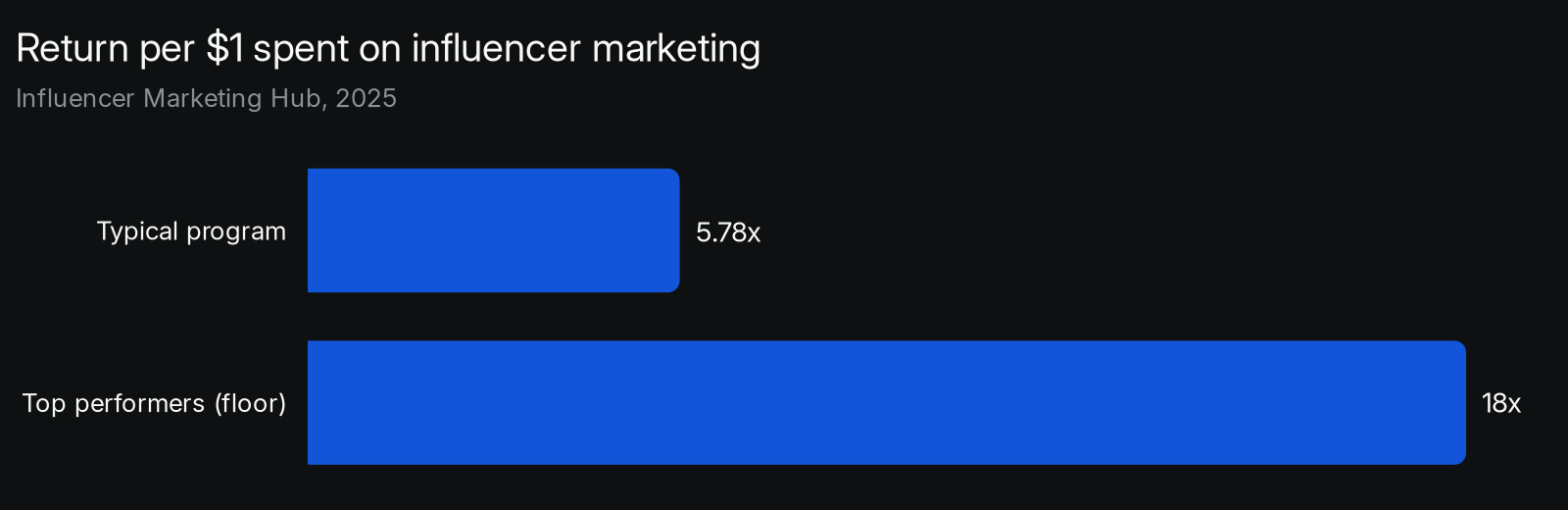
Revenue has the opposite problem: it gets undercounted. Last-click attribution credits only the final touch, so a creator who introduced a customer who bought two weeks later through a branded search shows up as zero. The benchmark for a healthy program is real money: average ROI per $1 spent on influencer marketing is $5.78, with top performers reaching $18 to $20 (Influencer Marketing Hub, 2025). You only see numbers like that when both sides of the formula are honest.
CPL, CPM, and LTV Reveal What Conversion Rate Misses
Conversion rate tells you whether a campaign worked once; the supplementary metrics tell you whether the channel is worth scaling. Cost per lead (CPL), cost per mille (CPM), and customer lifetime value (LTV) each surface a dimension that a single conversion number hides.
CPL tells you what each new lead actually cost across the campaign, which matters because finding the cost-efficient creator is the whole game when budgets are tight. CPM tells you the efficiency of pure reach, useful for awareness campaigns where the conversion has not happened yet. LTV is the most underused of the three: it answers whether the customers a creator brought in stick around and buy again, or churn after the discount code. A creator who delivers a slightly higher CPL but customers with double the LTV is the better partner, and conversion rate alone would never tell you that.
This is also where the case for recurring relationships gets quantitative. 56% of brands prefer to reuse the same creators across campaigns (Influencer Marketing Hub, 2025), and LTV is the metric that proves why: a creator whose audience converts into repeat buyers compounds in value every campaign you run with them.
First-Party Creator Data Changes What’s Measurable
The single biggest constraint on influencer ROI measurement is the quality of the data underneath it, and most of the industry is working off scraped, stale third-party records. Brands waste an estimated $4.6 billion per year on partnerships compromised by fake followers, with roughly 18% of influencer engagement estimated to be artificial (industry analysis, 2025). You cannot calculate honest ROI on a denominator of fake reach.
This is the part of the measurement stack that comes before attribution and before the formula: do you trust the creator’s numbers in the first place. More than half of marketers spend 30 minutes or less vetting a single influencer, and only 25.6% consistently receive vetting documentation (EMARKETER and Viral Nation, 2025). When the inputs are guesses, the ROI calculation is theater.
First-party data, the kind a creator OAuths and has a stake in keeping accurate, changes what is measurable. It gives you verified follower counts instead of scraped estimates, real engagement instead of bot-inflated rates, and actual brand-partnership history instead of a media kit’s claims. That is the foundation a real measurement framework sits on, and it is why the data layer is a measurement decision, not just a sourcing one.
A Repeatable Framework You Can Defend in a Budget Meeting
The payoff of the full stack is a framework you run the same way every campaign, which turns ROI from a one-off scramble into a defensible system. Measuring influencer ROI is what proves impact and secures larger future budgets, the exact thing 53% of marketers currently cannot do (Linqia, 2025).
Run it in this order, every time:
- Set one primary goal and lock its success metric before briefing any creator.
- Verify the creator’s data is first-party so your reach and engagement inputs are real, not scraped.
- Layer at least three attribution methods (UTM, promo code, survey) so you catch click, delayed, and dark-social paths.
- Calculate ROI with honest costs that include commission, usage rights, amplification, and internal hours.
- Read CPL, CPM, and LTV alongside conversion rate to separate a one-time win from a scalable channel.
- Compare across campaigns to find the recurring creators whose LTV compounds.
A brand that runs this consistently stops arguing about whether influencer marketing works and starts showing exactly what it returned. That is how you walk into the budget meeting with proof instead of a feeling, and walk out with a bigger line item.
Where Creatorland Sits Among the Tools You’d Use to Measure ROI
The measurement problem clusters around one decision: whether the data feeding your ROI calculation is first-party and verified or scraped and stale. The options below differ most on that axis and on whether they connect the creator’s actual deal flow or only the brand’s own outreach.
| Tool | Data source for measurement | What it closes the loop on |
|---|---|---|
| Creatorland | First-party data creators OAuth and keep accurate | Verified reach, real engagement, actual brand-deal history |
| CreatorIQ | ~20M scraped profiles via Creator Graph | Enterprise campaign reporting and brand-safety scoring |
| GRIN | Authenticated and opt-in creator records | Affiliate tracking and conversion attribution |
| Aspire | 1M+ marketplace creators, filter discovery | Campaign performance reporting and content tracking |
| Traackr | 6M to 13M database, Brand Vitality Score | ROI analytics scoring, strong in beauty |
CreatorIQ, GRIN, Aspire, and Traackr all report on the campaigns you run through them, but they read the brand’s own outreach, not the creator’s real deal flow. Creatorland inverts that: the data is first-party because the creator has a stake in keeping it accurate, which is the foundation an honest ROI number actually needs.
Frequently Asked Questions
How long should I wait before measuring a campaign’s ROI?
Match the window to the goal you set. Conversion campaigns can read attributed sales within the standard tracking window, but awareness and relationship campaigns compound over quarters, since long-term collaborations generate up to 70% higher engagement than one-offs (Archive, 2025). Measuring a relationship campaign on a single post’s numbers will undercount it badly.
Why does last-click attribution undercount influencer ROI?
Last-click credits only the final touch before purchase, so a creator who introduced a customer who bought weeks later through branded search shows up as zero. Nearly half of consumers make a purchase at least once a month because of influencer posts, according to Sprout Social’s 2024 Influencer Marketing Report, but those paths rarely end in a same-session click. A multi-touch model is the only way to credit the full journey.
What costs do most teams forget to include in the ROI formula?
The creator fee is the obvious one; the missing ones are talent commission (typically 15% to 20%, per Campaign US), content usage rights, paid amplification behind the post, and internal coordination hours. A campaign averages 17 or more unique points of contact over a 4-to-8-week cycle (Influencer Hero, 2025), so the labor is real. Omitting these inflates your ROI and sets a number you cannot repeat.
Is conversion rate enough to judge a creator partnership?
No. Conversion rate tells you a campaign worked once, but it hides whether the customers stick. A creator with a slightly higher cost per lead but double the customer lifetime value is the better long-term partner, which is exactly why 56% of brands prefer to reuse the same creators across campaigns (Influencer Marketing Hub, 2025).
How does fake engagement break ROI measurement specifically?
It corrupts the inputs before you ever run the formula. With roughly 18% of influencer engagement estimated to be artificial and $4.6 billion wasted annually on fake-follower-compromised partnerships (industry analysis, 2025), an ROI calculated on inflated reach is fiction. Verified first-party data is the only way to trust the denominator.
Which attribution method should I start with if I can only run one?
Start with unique promo codes per creator, because they catch both immediate and delayed buyers and require no technical setup. Add UTM parameters next for click tracking, then post-purchase surveys to catch dark-social discovery. The methods stack because each one catches a slice the others miss.
How do I use ROI proof to get a bigger budget?
Bring a campaign-over-campaign comparison, not a single number. Show that ROI per $1 is trending toward the $5.78 industry average or beyond (Influencer Marketing Hub, 2025), and that your recurring creators show rising LTV. A defensible framework run the same way every time is what turns a budget request into a budget approval.
How Creatorland’s First-Party Data Layer Fixes the Measurement Denominator
Every measurement framework in this guide depends on one thing the industry mostly gets wrong: whether the creator data feeding it is real. Creatorland is the professional network for the creator economy, built on first-party data that creators OAuth into through Instagram, TikTok, and YouTube and have a direct stake in keeping accurate, which is the verified denominator an honest ROI calculation requires. Where brand-side CRMs read scraped third-party profiles, Creatorland reads verified social presence, real engagement, and actual brand-partnership history.
The deal flow itself is where the other half of measurement lives. DealSync connects a creator’s Gmail and reads every brand-partnership thread into a structured deal CRM, sorting each conversation by stage. In its current beta with 913 creators, it has processed 5.58 million emails and identified 108,000 real brand deals across 26,700 unique brands, the kind of closed-deal data that makes fair-rate benchmarking and real ROI comparison possible in the first place. On the brand side, the Creatorland Data MCP plugs that same first-party layer into Claude, Cursor, or Perplexity, so a marketing team can query verified creator profiles and median rate bands derived from real closed deals, not scraped guesses.
Creatorland is rated through testimonials from the ex Head of Creators at Pinterest, the management of The Sidemen, and brand-side VPs of Marketing, with one VP noting the alternative discovery tools cost a staggering $28k a year while lacking the features they need. The platform counts 97,000+ members with 300% year-over-year growth and $0 spent on marketing, built on the premise that the data is first-party or it is wrong.