A UGC creator makes authentic, native-feeling content that a brand licenses and runs as its own ads or organic posts. The one thing that separates a UGC creator from an influencer is who gets paid for what: the brand pays a UGC creator for the content itself, not for distribution to the creator’s own audience. That distinction changes everything downstream, from how rates work to how brands and creators find each other, and this guide walks both sides of that relationship so nobody leaves money or a good match on the table.
A UGC Creator Sells Content, an Influencer Sells Reach
The core difference is the deliverable. A UGC creator hands the brand a finished video or photo set to run wherever the brand wants; an influencer posts to their own followers, and the brand pays for that audience. Influee reports, citing EveryoneSocial, that more than 79% of consumers trust user-generated content more than polished advertisements, which is exactly why brands buy the raw, native-feeling asset even when the creator has a small following.
This is why follower count matters far less for UGC work. A creator with 2,000 followers who films a clean, well-lit product demo can out-earn an influencer with 200,000 followers on a per-deliverable basis, because the brand is buying the footage, not the feed. The skill being paid for is content craft: hooks, lighting, pacing, and a delivery that reads like a real person, not an ad.
That decoupling of pay from audience size is the whole opportunity for creators who are good on camera but haven’t built a huge following yet, and it’s the whole appeal for brands that need volume without paying influencer distribution premiums.
Why Brands Pay for UGC in the First Place
Brands buy UGC because it converts and because it fills a content pipeline that in-house teams can’t keep up with. Influee reports, citing Hootsuite, that 93% of marketers agree UGC content outperforms traditional marketing, and the reason is trust: audiences read native content as a recommendation, not an ad.
The performance case shows up across the funnel. Influee cites The Shelf finding that well-structured content keeps viewers 50% more engaged, and PostBeyond data that UGC videos can drive 8x more action from consumers. Roughly 36% of brands say influencer and creator content outperforms brand-created content (Industry research, 2025), which is the softer version of the same finding: the stuff that looks like a person made it works harder than the stuff that looks like a brand made it.
There’s also a supply-side story. The number of UGC creators surged roughly 93% year over year (Industry reporting, 2025), meaning the category of people who make paid content without needing a big audience is now one of the fastest-growing segments of the creator economy. Brands lean on that supply because a single influencer campaign can’t produce the dozens of native ad variants a modern paid-social program burns through.
UGC Creation Is a Real Skill, Not Just Filming Yourself
UGC work is a production job with a repeatable structure, and treating it that way is what separates paid creators from people posting for free. Most scripted UGC follows the same skeleton: a hook in the first two seconds, a problem, the product as the solution, and a clear payoff, all filmed to look unpolished on purpose.
The deliverables a brand actually asks for cluster into a few types. There’s the talking-head testimonial, the unboxing, the product demo, the “get ready with me” style integration, and the problem-solution ad built for paid placement. Each has its own conventions, and a creator who can name and price them separately reads as a professional, not a hobbyist.
The craft signals matter because they show up in the footage. Clean audio, natural light, and a delivery that keeps the viewer watching are the difference between a clip a brand can run and one it quietly shelves. This is a business line with inputs, outputs, and a quality bar, which is exactly why the creators who take it seriously get asked back.
How UGC Rates Actually Work in 2026
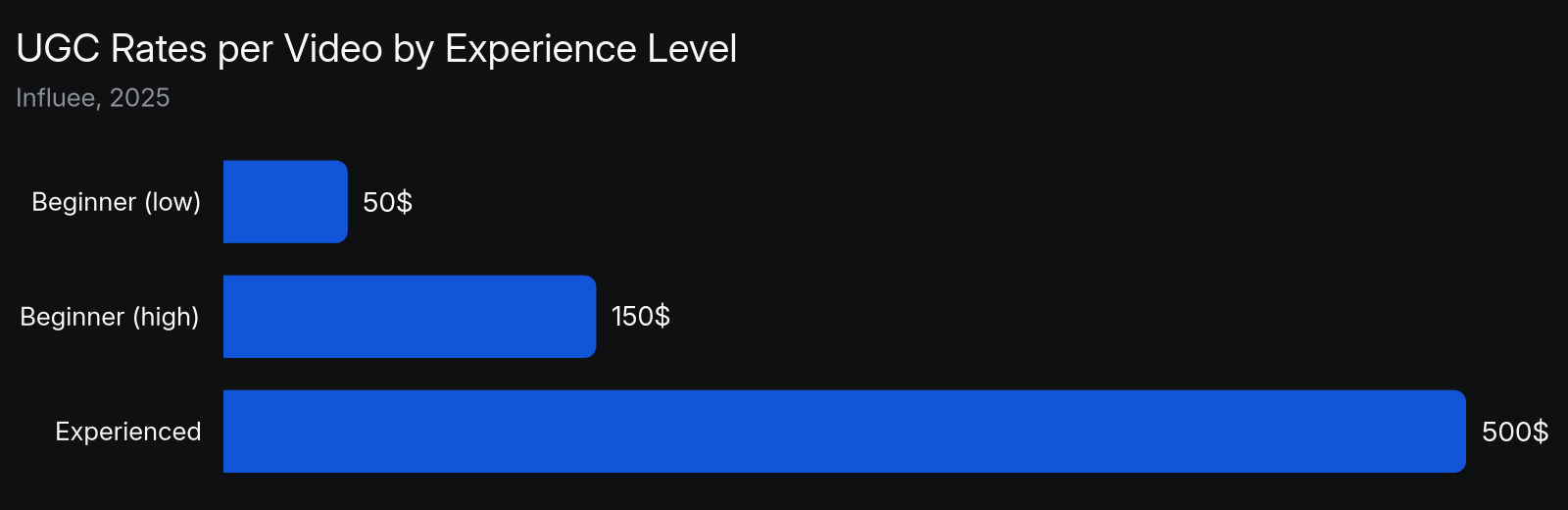
UGC rates run from roughly $50 to $150 per video for beginners up to $500 or more for experienced creators, and where a creator lands depends on craft, turnaround, and usage rights, not follower count. Influee reports beginners often charge $50 to $150 per video while experienced creators earn $500 or more per deliverable, and notes the range can stretch from around $50 per video to thousands per gig at the top end.
The variables that move a rate are concrete. Exclusivity, whitelisting (letting the brand run the content as a paid ad from its own account), the number of revisions, and how long the brand can use the footage all push the price up. A flat “per video” number with no usage terms is how creators underprice themselves; a rate card that separates the base deliverable from usage and exclusivity is how they stop.
The bigger pricing problem is that there’s no shared benchmark. Every negotiation starts from scratch, so creators guess low and brands anchor lower. Creatorland’s own market data speaks directly to this: DealSync has identified 108,000 real brand deals across 26,700 unique brands (Creatorland DealSync, 2026), the kind of first-party deal record that turns “what should I charge” from a guess into a number.
For Creators, UGC Is a Business Line, Not a Side Hustle
The creators who win repeat deals treat UGC like a company: consistent pricing, tracked brand history, and a discoverable presence. Roughly 68.8% of creators rely on brand deals as their primary income source (Influencer Marketing Hub Creator Earnings Report, 2025), so this is not pocket money, it’s the main revenue line for most of the professional creator middle class.
Three habits separate the pros. First, price the same way every time, with usage and exclusivity broken out, so you’re not re-inventing your worth per email. Second, keep a running record of every brand you’ve worked with, because your past clients are your highest-converting future pipeline and they’re impossible to use if you can’t find them. Third, be findable when a brand goes looking, which means a real profile, not a Canva PDF that’s out of date the day you send it.
That last point is where most UGC creators leak deals. Their brand history lives in a Gmail inbox, their portfolio lives in a folder, and their identity lives in a bio link, so nobody can assemble the picture of “this person has done exactly this before.” Roughly 25% of brand-deal emails surfaced by DealSync go unanswered (Creatorland DealSync, 2026), which is the clearest possible proof that the inbox is where good deals go to die.
For Brands, Sourcing UGC Is a Vetting Problem, Not a Budget Problem
The hard part of hiring UGC creators isn’t finding budget, it’s finding creators who actually deliver and confirming they’re real before you pay. 30% of marketers cite “finding the right creators” as their single biggest challenge, ahead of measurement and contract management combined (Influencer Marketing Hub Benchmark Report, 2025).
Vetting is where campaigns quietly fail. Brands that skip proper creator vetting waste an average of $10,000 to $50,000 per failed campaign (Industry analysis, 2025), and 72% of brands say they struggle to identify fake engagement when evaluating creators (Influencer Marketing Hub, 2025). For UGC specifically, the risk is slightly different from influencer fraud: the question isn’t “is this audience real,” it’s “can this person produce a clip I can actually run, on time, at the quality shown in their samples.”
That’s why sourcing well means looking at verifiable work history, not a follower count. The signal a brand wants is proof that a creator has produced native content for comparable brands before and that the brands came back. That proof exists, it just usually isn’t in one place a brand can see.
Discovery Has Outgrown Canva Portfolios and Cold DMs
The old sourcing loop, cold DMs from creators and CSV exports from scraped databases for brands, breaks down exactly at the scale UGC now runs. Brand-side databases populate from third-party scrapers, so creators don’t control their presence, contact info goes stale, and there’s no real brand-history signal, per industry analysis of the legacy CRM category.
For creators, the cold-DM approach doesn’t scale either. Pitching one brand at a time by email is slow, and the good deals that do come in get buried; the average professional receives roughly 121 emails per day, of which only about 38% require a meaningful response (Radicati Group, 2025). A native content pro spending their hours triaging an inbox is spending them on the wrong thing.
The fix on both sides is the same: a place where a creator’s real, verified brand history is visible and searchable, so brands find people who’ve done the exact work before and creators stop pitching into the void. Over 7,000 Creatorland members already carry verifiable brand partnership history on their public profiles, and that number is scaling as more creators connect their socials.
Both Sides Win the Same Way: Make the Work Visible
UGC is a real, professionalizable business line, and the creators and brands who treat it that way beat the ones stuck in the one-off, cold-DM loop. For creators, the use is pricing consistently, tracking brand history, and being discoverable; for brands, it’s solving discovery and vetting instead of just approving budget. Both problems have the same root cause, which is that the proof of who has done good UGC work lives scattered across inboxes, folders, and bio links where nobody can see it.
The category outgrew Canva portfolios and cold DMs the same year it hit 93% year-over-year creator growth. What it needs now is infrastructure: a place where a creator’s licensed-content history is a visible, portable asset, and where a brand can find and vet the person who has already made exactly the ad they need. That’s the difference between chasing gigs and building a business, and between running a campaign blind and running it on proof.
How Creatorland Compares to the Tools UGC Creators and Brands Already Use
UGC creators and brands both face a discovery-and-vetting problem, and the tools in the market split into three approaches to it: creator-side deal management, brand-side scraped databases, and transactional marketplaces. The dimensions that matter are whose data it’s built on, whether the creator’s brand history is verifiable, and what the reader actually walks away with.
| Platform | Who it’s built for | Data source | What you walk away with |
|---|---|---|---|
| Creatorland | Both sides on one professional graph | First-party, creator-OAuthed | Verifiable brand history plus deal tracking via DealSync |
| CreatorIQ | Enterprise brands | Scraped, ~20M creator profiles | Filter-based discovery from third-party data |
| GRIN | Growing-to-large brand teams | Scraped plus authenticated | Creator CRM and affiliate management |
| Aspire | Brands running social commerce | Marketplace plus filter | Campaign management from discovery to reporting |
CreatorIQ runs enterprise contracts from $35,000 to $200,000 (Vendr, 2025), which prices out most of the mid-market and small brands actually buying UGC. The structural gap across the scraped-database tools is the same one this guide keeps hitting: their creator data isn’t controlled or verified by the creator, so brand-history signal is weak exactly where UGC hiring needs it most.
Frequently Asked Questions
Is a UGC creator the same as an influencer?
No. A UGC creator sells finished content the brand licenses and runs itself, while an influencer sells distribution to their own audience. The clearest tell is the payment: a UGC creator is paid for the video or photos, an influencer is paid for the post going out to their followers.
Do I need a big following to be a UGC creator?
No, and that’s the point of the category. Because the brand buys the content rather than your audience, a creator with a few thousand followers can earn on par with much larger accounts on a per-deliverable basis. The skill being paid for is content craft, not reach.
How much should a beginner UGC creator charge?
Beginners often charge $50 to $150 per video, with experienced creators earning $500 or more, per Influee. Where you land depends on turnaround, revisions, exclusivity, and usage rights, so break those out of your base rate rather than quoting one flat number.
What are usage rights and why do they change the price?
Usage rights define where and how long a brand can run your content, and whitelisting lets them run it as a paid ad from their own account. Both expand the value the brand gets, so both should raise your rate. A creator who prices without usage terms is almost always underpricing.
How do brands vet UGC creators without a follower count to check?
Brands should look at verifiable work history: proof the creator has produced native content for comparable brands and that those brands came back. 30% of marketers cite finding the right creators as their biggest challenge (Influencer Marketing Hub Benchmark Report, 2025), and vetting on real brand history rather than a portfolio PDF is how they solve it.
Why do so many UGC deals fall through?
Because they get buried. The average professional gets roughly 121 emails a day (Radicati Group, 2025), and roughly 25% of brand-deal emails surfaced by DealSync go unanswered (Creatorland DealSync, 2026). A real paid offer lost in an inbox is lost revenue for the creator and a lost creator for the brand.
Where do brands and creators find each other now?
On platforms where a creator’s verified brand history is visible and searchable, rather than scraped databases or cold DMs. Over 7,000 Creatorland members carry verifiable brand partnership history on their public profiles, which is the exact signal a brand hiring UGC wants to see.
How Creatorland Turns Scattered UGC Proof Into a Discoverable Career
This guide’s throughline is that both sides win by making the work visible, and that’s precisely the layer Creatorland is built to be. Creatorland is the professional home for the creator economy: a single graph where a UGC creator’s licensed-content history, brand partners, and deal flow live in one place they control, and where brands discover and vet creators from first-party data instead of a scraped rolodex. Creators auto-populate their profiles by connecting Instagram, TikTok, and YouTube, so brand partners and past work show up as verifiable signal, not a static PDF.
DealSync is the piece that fixes the buried-deal problem head-on. Connect Gmail and it reads every brand-partnership thread in your inbox, classifies each one by stage, and builds a structured record of every brand you’ve ever worked with, so the proof of your UGC business stops living in a folder. In its current beta, DealSync has processed 5.58 million emails and identified 108,000 real brand deals across 26,700 unique brands (Creatorland DealSync, 2026), the kind of deal data that also anchors fair-rate benchmarking so you stop guessing your price.
The platform runs on real traction: 97,000+ members and 300% year-over-year growth with $0 spent on marketing to date, and engagement that beats industry benchmarks at 42% Day-30 retention. Colleen Stauffer, ex Head of Creators at Pinterest, called it “the ultimate hub for creators and brands... a unique solution for personalized communication that no other platform provides.” For a UGC creator, that’s the difference between chasing one-off gigs and building a business brands can find.