Every year the surveys say the same thing: brands cannot find the right creators. Not measurement, not contracts, not budget approval. The single hardest part of running an influencer program is still the first step, deciding who to work with. And the tools built to fix it, the ones that cost $30,000 to $200,000 a year, have not moved the number because they are all standing on the same broken foundation. This article is for the brand-side marketer who keeps paying for discovery and keeps coming up short, and the argument is simple: you do not have a search problem, you have a data problem.
Finding the Right Creators Is Still the Number One Pain Point
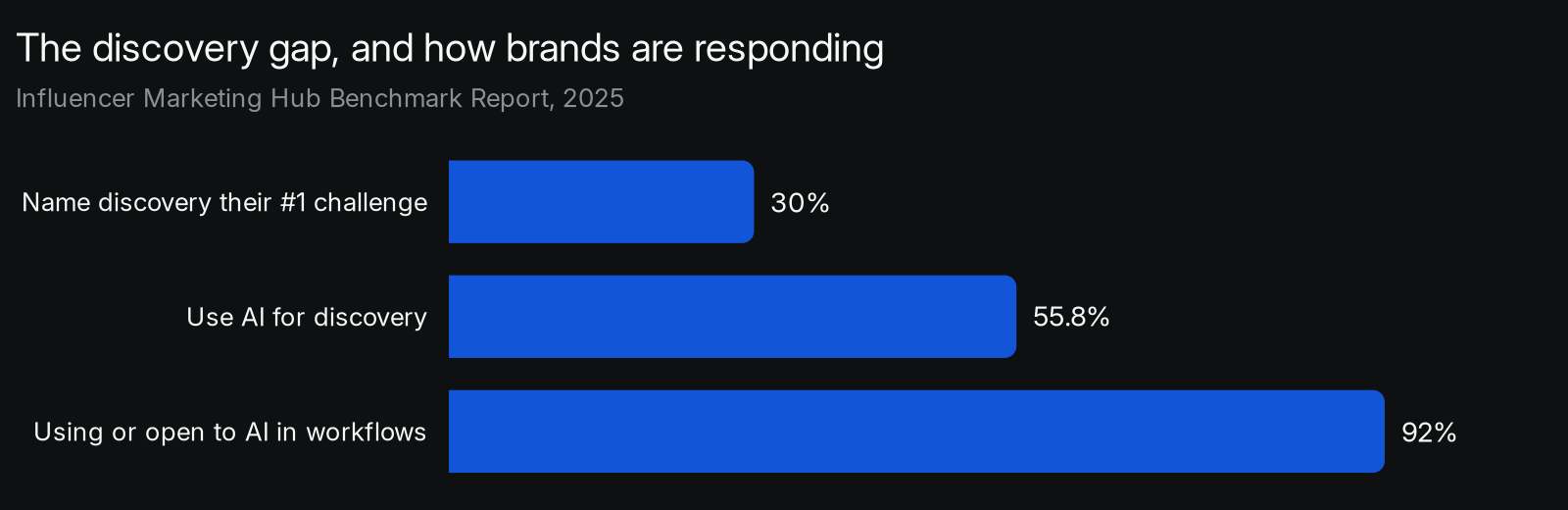
Discovery is the hardest part of influencer marketing, and it has been for years. 30% of marketers name “finding the right creators” as their single biggest challenge, ranking above campaign measurement and contract management combined (Influencer Marketing Hub Benchmark Report, 2025). That is not a soft preference. It is the one task that beats every downstream headache in a category that has matured into a $40.51 billion global market (Mordor Intelligence, 2026).
The spend has scaled, the workflows have professionalized, and the discovery problem has not budged. When Impact.com announced its influencer and creator management platform, the company framed the entire pitch around consolidating fragmented partnership tooling onto a single dashboard, an admission from a major vendor that the find-and-vet layer underneath the industry is still a mess. Brands are not short on tools. They are short on a way to find people they can trust.
Brands Are Already Reaching for AI to Close the Gap
Brands have already voted with their workflows: AI is now the default response to the discovery problem. 55.8% of marketers use AI specifically for influencer discovery, the single most common AI application in influencer marketing (Influencer Marketing Hub Benchmark Report, 2025). When more than half a category adopts a tactic for one job, that job is the bottleneck.
The reach goes wider than discovery alone. 92% of brands are already using or open to using AI to support influencer marketing workflows, with creator discovery the most-cited use case (Influencer Marketing Hub, 2025). The instinct is right. The problem is what most of that AI is pointed at: it is searching faster across the same flawed records, not fixing the records.
The Discovery Problem Is a Data Problem, Not a Search Problem
The reason discovery never gets solved is that it has been misdiagnosed for a decade. Every legacy tool treats it as a search problem, so every roadmap adds more filters, better ranking, and now an AI layer. But you cannot filter your way out of bad source data. The records underneath are scraped, stale, and third-party, and creators never opted into them or had any reason to keep them accurate.
The downstream cost is real money. 72% of brands report they struggle to identify fake engagement when evaluating creators (Influencer Marketing Hub, 2025), which is why follower count is a worthless signal on its own. Brands waste an estimated $4.6 billion per year on partnerships compromised by fake followers (industry analysis, 2025). More filters on a corrupted dataset return faster wrong answers, not better creators.
Why Scraped Third-Party Data Keeps Breaking Discovery
The legacy CRM category runs on databases nobody on the creator side maintains. CreatorIQ’s 20-million-creator database “frequently produces irrelevant results” because it relies on scraped public profiles rather than creator-volunteered data, and its enterprise pricing is “out of range for small and mid-market businesses,” according to Modash’s 2025 analysis. That is the architecture, not a bug in one product.
GRIN’s filter-based search “returns the same overexposed, overpriced names, and misses the niche creators who actually drive results,” a limitation industry analysis attributes to the scraped third-party foundation shared across the whole legacy category (GRIN, 2025). When the data is gathered without the creator’s involvement, contact info goes wrong, brand history is missing, and the freshness signal is whatever the last scrape happened to catch. You are hiring against a snapshot of someone who never agreed to be in the file.
First-Party Data Is the Only Fix for the Root Cause
The fix is structural: the data has to come from the creator, with the creator’s stake in keeping it accurate. That is the entire difference between a record someone scraped and a record someone owns. On Creatorland, creators OAuth their Instagram, TikTok, and YouTube accounts and control a living professional graph, so verified follower counts, engagement, brand partnerships, and audience data come from the source rather than a crawler.
This is the inversion the category has avoided: the creator is the customer, not the inventory. Across the network, more than 7,000 members already carry verifiable brand partnership history visible on their public profiles through brand partner tags, mentions, and collaborator links, and that number is scaling as more members complete profiles and connect socials. That is the signal scraped databases structurally cannot produce, because it depends on the person being hired having a reason to keep it true.
How the Creatorland MCP Attacks the Root Cause
The Creatorland Data MCP is the first discovery tool built on first-party data instead of filters on broken records. It queries a discovery pool of over 2.6 million creators, 800K+ indexed posts, and a brand catalog with thousands of canonical brands and verified creator-brand affiliations, all from data creators OAuth into and have a stake in keeping accurate. Marketers reach that data from inside the AI tools they already run.
Three direct tool calls do the work. search-creators takes a structured campaign brief or a lookalike seed and returns ranked matches from the 2.6M+ corpus, each with audience data, brand affiliation history, and freshness status. get-creator-profile resolves a handle, email, or ID into verified social presence, brand partnership history, and audience geography without exposing PII. query-market-intelligence returns p25, median, and p75 rate bands derived from real closed deals, so the brief comes with a market-credible price band attached. That is targeting and pricing grounded in what actually happened, not a scraped guess.
The Discovery Problem Stays Unsolved Until the Data Layer Changes
Brands will keep naming discovery their number one challenge until someone fixes the layer underneath it. Adding AI to a scraped database makes a bad answer arrive faster; it does not make the answer right. The reason 30% of marketers still rank finding the right creators above measurement and contracts combined is that every tool they have bought attacks the symptom and leaves the cause, third-party data nobody on the creator side maintains, untouched.
First-party data flips that. When the creator owns the record and has a stake in its accuracy, discovery stops being a search problem and becomes a lookup against something true. That is the bet the Creatorland MCP is built on, and it is the only one that reaches the root.
Where the Creatorland MCP Sits in the Discovery Landscape
Every tool in this category is trying to solve the same problem, finding the right creators, and they cluster around one of two foundations: scraped third-party databases or first-party creator data. The table below compares the data foundation, the creator’s control over their own record, and the entry price, the three dimensions that decide whether discovery actually works.
| Tool | Data foundation | Creator controls own record | Entry price |
|---|---|---|---|
| Creatorland MCP | First-party, creator-OAuthed across 2.6M+ creators | Yes, creators OAuth and own the graph | $199/mo pilot |
| CreatorIQ | Scraped public profiles, ~20M creators | No | $35,000/yr |
| GRIN | Authenticated and opt-in, 190M+ creators | Partial, filter search misses niche | $25,000/yr+ |
| Aspire | Marketplace plus filter discovery, 1M+ | Marketplace opt-in only | Custom |
| Modash | Scraped public profiles, 350M+ | No | $199/mo |
Frequently Asked Questions
Why do brands still struggle to find creators when there are so many tools?
Because the tools fix the wrong layer. Most discovery platforms add search filters and AI ranking on top of scraped third-party databases, so they return faster results from the same flawed records. The bottleneck is data quality, not search speed, which is why 30% of marketers still name discovery their single biggest challenge (Influencer Marketing Hub Benchmark Report, 2025).
What is the difference between scraped data and first-party creator data?
Scraped data is gathered by crawling public profiles without the creator’s involvement, so contact info goes stale and brand history is missing. First-party data comes from the creator directly, who OAuths their socials and controls their own record. The creator has a stake in keeping it accurate because it is their professional profile, not a file someone built about them.
Does adding AI to a creator database fix the discovery problem?
Not on its own. AI pointed at a scraped database makes a wrong answer arrive faster; it does not make the answer right. That is why 55.8% of marketers already use AI for discovery and the problem persists (Influencer Marketing Hub Benchmark Report, 2025). The data foundation has to change first.
How does the Creatorland MCP avoid returning fake or inflated accounts?
It queries verified, creator-OAuthed records rather than scraped public profiles, so follower counts and engagement come from the source. This matters because 72% of brands struggle to identify fake engagement using conventional tools (Influencer Marketing Hub, 2025), and raw follower count from a scrape cannot be trusted as a vetting signal.
Can mid-market and small brands actually afford this?
Yes. Legacy creator CRMs run $25,000 to $200,000 a year, structurally out of reach for anyone below F500. The Creatorland MCP runs at $199 per month in pilot pricing, with an early-adopter program offering 50% off the standard $250 rate through Summer 2026.
Which AI tools does the Creatorland MCP work inside?
It connects to 11 AI tools including Claude, Claude Cowork, Cursor, Perplexity, v0, and OpenAI Codex. Claude and Cowork users install the full plugin and skill catalog with one command, and the first tool call triggers OAuth sign-in, so there is no manual API key management.
What can the MCP tell me about pricing a creator?
The query-market-intelligence tool returns p25, median, and p75 rate bands derived from real closed deals in the Creatorland corpus, scoped to a vertical, platform, deal type, and follower tier. It includes a minimum-N privacy floor so no individual deal is reconstructible, giving you a market-credible price band before you ever send an offer.
How the Creatorland MCP Fixes Discovery at the Data Layer, Not the Filter Layer
The whole argument of this piece is that discovery stays broken because every tool patches the search layer and leaves the scraped-data foundation untouched. The Creatorland Data MCP is the first to attack the root cause. It plugs Creatorland’s first-party creator graph, over 2.6 million creators, 800K+ indexed posts, and thousands of canonical brand affiliations, directly into Claude, Cursor, Perplexity, or any agent harness a marketing team already uses, with built-in privacy guarantees against individual-record reconstruction.
The data is the differentiator. Creators OAuth their socials and control their own records, so when an agent runs search-creators against a brief or resolves a profile with get-creator-profile, it is reading verified, current data the creator has a stake in keeping accurate. That same foundation powers 40+ pre-built workflow skills, from casting a brief into a ranked shortlist to benchmarking a quote against real closed-deal rate bands. Brand-side marketers come for the discovery and find the vetting, the pricing intelligence, and the wrap reporting on the same data layer.
Pilot pricing runs through Summer 2026 at $199 per month, with the early-adopter program offering 50% off the standard $250 rate plus dedicated onboarding and support. For a category where the cheapest serious incumbent starts around $25,000 a year, that is the first time the right data foundation has been priced for brands of every size.