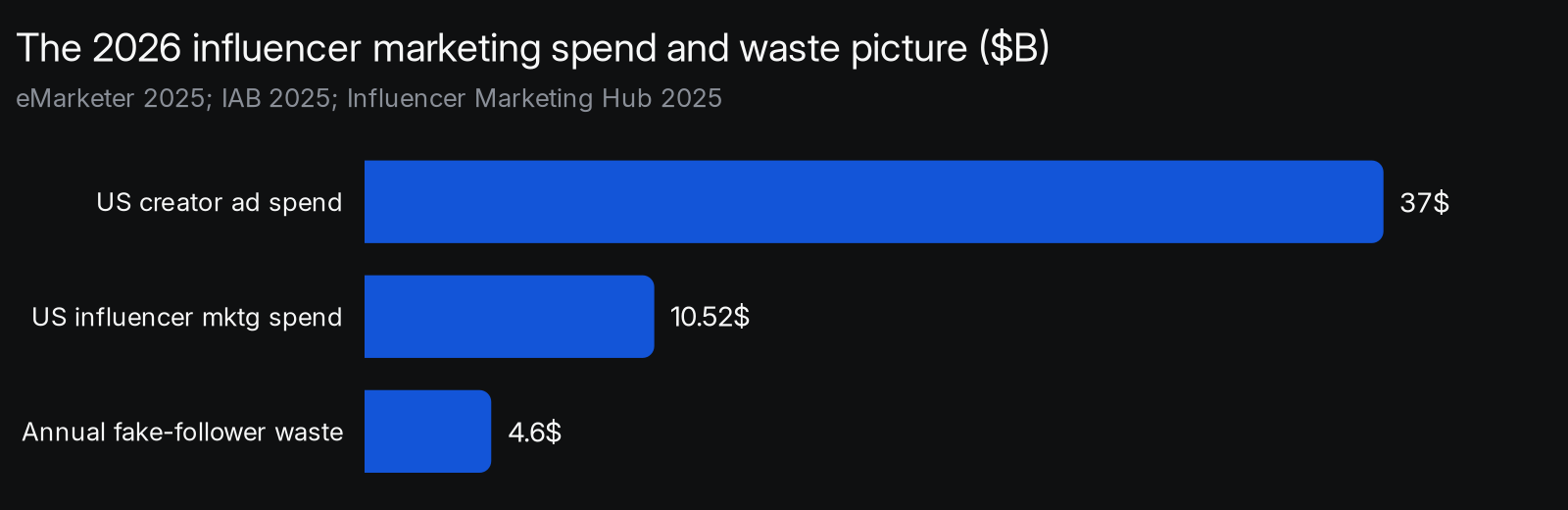
Here is the thing nobody running a creator program in 2026 can ignore: the gap between the brands winning and the brands burning budget is no longer about who spends the most. It is about who replaced gut feel and spreadsheet chaos with first-party creator data, AI-powered discovery, and agentic workflows. US influencer marketing spend hit $10.52 billion in 2025 and is projected to reach $13.7 billion by 2027 (eMarketer, 2025), while US creator ad spend reached $37 billion in 2025, growing four times faster than total media spend (IAB, 2025). The money is pouring in. The question is whether your strategy is built for how this works now, or how it worked three years ago.
This is written for the brand side: the influencer marketing managers, creator partnerships leads, and founders hiring creators directly. Below are the five structural shifts that define the 2026 playbook, and the data layer that makes the new version executable without a six-figure enterprise contract.
Shift 1: Discovery Moved From Follower Count to First-Party Data
The brands pulling ahead stopped searching by follower count and started searching by verified, creator-controlled data. Creator discovery and vetting is the function brands most often hand to an outside partner, at 19.44% of all outsourced work, ahead of content production (Influencer Marketing Hub, 2025). That is a direct signal: finding the right creators is the hardest part of the job to staff internally, and it is the part most teams get wrong.
The reason discovery breaks is a data problem, not a search problem. Legacy CRMs populate their databases from scraped public profiles, which means the data is stale the moment it is collected and the creator never volunteered it. Modash has noted that CreatorIQ’s 20-million-creator database “frequently produces irrelevant results” precisely because it relies on scraped profiles rather than creator-volunteered data (Modash, 2025). When the underlying data is scraped, every downstream decision inherits the rot.
First-party data inverts the whole thing. When a creator OAuths their socials and controls their own presence, the follower counts are verified, the brand history is real, and the contact info actually works. That is the difference between guessing and knowing before you spend a dollar.
Shift 2: Vetting Got Serious Because Fake Engagement Got Expensive
Leading brands now treat vetting as the highest-use step in the entire campaign, not a formality. Brands waste an estimated $4.6 billion per year on influencer partnerships compromised by fake followers, and roughly 18% of influencer engagement is estimated to be artificial (industry analysis, 2025). That is not a rounding error. That is a structural tax on every team still vetting by eyeballing a follower count.
The problem is that most teams are not resourced to vet properly. More than half of marketers spend 30 minutes or less vetting a single influencer, and only 25.6% consistently receive vetting documentation (EMARKETER and Viral Nation, 2025). Meanwhile 72% of brands report they struggle to identify fake engagement when evaluating creators (Influencer Marketing Hub, 2025). The combination is brutal: brands know follower count is an unreliable signal, and they do not have time to dig deeper.
A skipped vetting step costs an average of $10,000 to $50,000 per failed campaign (industry analysis, 2025). The brands avoiding that hit are the ones querying real engagement data, audience composition, and brand-safety history before they reach out, not after the deal goes sideways.
Shift 3: Relationships Beat One-Off Campaigns
The winning move in 2026 is to stop running every campaign as a cold start and build a relationship graph instead. 56% of brands now prefer to reuse the same creators across campaigns (Influencer Marketing Hub, 2025), and sustained collaborations generate up to 70% higher engagement than one-offs (Archive Brand Creator Collaboration Report, 2025). The math favors relationships, hard.
The catch is that the prevailing reality still does not match the stated preference. 72% of TikTok brand relationships end after a single collaboration (Creatorland community sentiment analysis, 2026), even as most brands say they want long-term partnerships. The gap exists because the infrastructure to track and nurture relationships at scale has not existed for anyone below the enterprise tier.
That is also where price discovery comes in. 71% of influencers offer discounts for longer-term partnerships (Influencer Marketing Hub, 2025), so the brands building a relationship graph are not just getting better engagement, they are paying less per touchpoint. A program built on who you have worked with, at what price, with what outcome, compounds. A program built on a fresh CSV export every quarter does not.
Shift 4: Agentic Workflows Cut the Manual Overhead Out of Every Stage
The biggest 2026 shift is brands handing the repetitive campaign work to AI agents and keeping humans on judgment. 92% of brands are already using or open to using AI to support influencer marketing workflows, with creator discovery the most-cited use case (Influencer Marketing Hub, 2025). This is no longer experimental. It is the operating default for teams running at volume.
The manual overhead is staggering. A typical brand-creator campaign requires an average of 17 or more unique points of contact across a 4-to-8-week cycle (Influencer Hero, 2025), and AI-powered creator discovery has been shown to cut search time by about 85% versus manual sourcing (industry analysis, 2025). Every one of those touches is a place a deal stalls, a reply gets buried, or a shortlist goes stale.
Agentic workflows attack the whole chain: a brief becomes a ranked shortlist, the shortlist gets conflict-checked, outreach drafts itself and waterfalls through tiers, and the wrap report assembles from real performance data. The human sets the objective and approves the decisions. The agent does the 17 touches.
Shift 5: Measurement Finally Closes the Loop
Brands pulling ahead measure against real outcomes instead of optimizing for proxy metrics they cannot trust. 53% of marketers struggle to determine the exact ROI of their influencer programs (Linqia, 2025), which is why so much spend still chases awareness numbers instead of conversion proof. The measurement gap is the reason finance keeps questioning the channel.
The fix is closing the loop between what you paid, who you paid, and what it produced. Average ROI per $1 spent on influencer marketing is $5.78, with top performers reaching $18 to $20 (Influencer Marketing Hub, 2025). The spread between average and top performer is almost entirely a measurement and targeting story. The brands at the top of that range know which creators drove sales because they tracked the deal from brief to wrap report on connected data.
That only works when the data underneath is first-party and current. You cannot attribute outcomes to creators when the profiles are scraped, the rates are guessed, and the brand history is a black box. Measurement closes the loop only when every other shift is already in place.
The 2026 Playbook Rewards Infrastructure, Not Budget
The five shifts share one root: every one of them depends on first-party creator data, and the brands winning are the ones who got access to it without signing a six-figure enterprise contract. Discovery, vetting, relationships, agentic workflows, and measurement all collapse back to the same question. Is the data underneath your program scraped and stale, or first-party and current?
That is the real rewrite of the playbook. It was never about who spent the most. It was about who built their program on data creators have a stake in keeping accurate, and who automated the manual overhead so the team spends its hours on judgment instead of CSV exports. The budget keeps growing toward $13.7 billion by 2027 (eMarketer, 2025). The brands that pull ahead will be the ones whose infrastructure was ready for it.
How the Creator Data Approaches Stack Up
The brands executing the 2026 playbook are choosing between three structurally different ways to get creator data, and the choice decides everything downstream. The dimensions that matter are where the data comes from, who it was priced for, and whether it plugs into the agentic workflows now running the manual work.
| Approach | How the data is sourced | Built for | Plugs into AI agents |
|---|---|---|---|
| Creatorland MCP | First-party data creators OAuth and control | Brands of every size at $199/mo pilot pricing | Yes, native MCP server for Claude, Cursor, Perplexity |
| CreatorIQ | Scraped public profiles, ~20M creator graph | Enterprise buyers at $35K to $200K/year | Limited, platform-bound workflows |
| GRIN | Scraped plus Instagram-integrated search | Mid-market and DTC ecommerce teams | No native agent layer |
| Manual / spreadsheets | CSV exports, gut feel, static media kits | Teams locked out of enterprise tooling | No |
CreatorIQ and GRIN both run powerful platforms, but both populate from scraped third-party data and both price the serious tiers out of reach for anyone below F500. The Creatorland MCP is the only row built on data creators volunteer and control, priced for mid-market and small brands, and exposed natively to the AI agents now doing the heavy lifting.
Frequently Asked Questions
How is building an influencer strategy in 2026 different from a few years ago?
The core shift is that 2026 strategy is data-led and agent-assisted, not gut-led and manual. 92% of brands are already using or open to using AI in their influencer workflows (Influencer Marketing Hub, 2025), with discovery the top use case. The brands pulling ahead replaced spreadsheet tracking and follower-count searches with first-party data and agentic automation across every stage.
Why does first-party creator data matter more than a bigger database?
A bigger scraped database often produces more irrelevant results, not fewer. Modash has noted that CreatorIQ’s 20-million-creator database “frequently produces irrelevant results” because it relies on scraped profiles rather than creator-volunteered data (Modash, 2025). First-party data is verified, current, and controlled by the creator, so discovery, vetting, and measurement all inherit accurate inputs instead of stale ones.
How much does fake engagement actually cost a campaign?
Brands waste an estimated $4.6 billion per year on partnerships compromised by fake followers (industry analysis, 2025), and skipping proper vetting costs an average of $10,000 to $50,000 per failed campaign. Since 72% of brands struggle to identify fake engagement (Influencer Marketing Hub, 2025), vetting against real engagement and audience data before you reach out is the highest-use step in the process.
Should I run one-off campaigns or build long-term creator relationships?
Build relationships where you can, because the data favors it heavily. Sustained collaborations generate up to 70% higher engagement than one-offs (Archive, 2025), 56% of brands now prefer reusing the same creators (Influencer Marketing Hub, 2025), and 71% of influencers discount longer-term deals. The blocker has been infrastructure to track relationships, which is exactly what a first-party creator graph provides.
Do I need an enterprise contract to run the 2026 playbook?
No, and that is the central change. Enterprise creator CRMs like CreatorIQ and GRIN run $25,000 to $200,000 per year (Vendr, 2025), structurally out of reach for mid-market and small brands. The Creatorland MCP delivers first-party data, discovery, and pricing intelligence at $199 per month in pilot pricing, removing the contract as a barrier to the new playbook.
What does an agentic influencer workflow actually replace?
It replaces the 17-plus manual touchpoints a typical campaign requires across a 4-to-8-week cycle (Influencer Hero, 2025). The agent turns a brief into a ranked shortlist, conflict-checks it, drafts and waterfalls outreach, benchmarks rates, and assembles the wrap report, while the human sets objectives and approves decisions. AI-powered discovery alone cuts search time by roughly 85% (industry analysis, 2025).
How do I close the ROI measurement gap on creator spend?
Track every deal from brief to wrap report on connected, first-party data so outcomes attribute to specific creators. 53% of marketers struggle to pin down exact ROI (Linqia, 2025), largely because scraped data and disconnected tools break attribution. Average ROI is $5.78 per $1 spent, with top performers hitting $18 to $20 (Influencer Marketing Hub, 2025), and the spread is mostly a targeting and measurement story.
How Creatorland’s MCP Runs the 2026 Playbook at $199 a Month
Every one of the five shifts depends on first-party creator data, and the Creatorland Data MCP is the layer that makes that data executable from inside the AI tools your team already runs. It queries a discovery pool of over 2.6 million creators, 800K+ indexed posts, and a brand catalog of thousands of canonical brands with verified creator-brand affiliations, all built on data creators OAuth into and have a stake in keeping accurate. You plug it into Claude, Cursor, Perplexity, or any agent harness, and the agent runs the full workflow.
The three core tool calls map directly to the playbook. search-creators turns a structured brief or a lookalike seed into a ranked shortlist from the 2.6M corpus; get-creator-profile returns verified social presence, brand history, and audience data for vetting; and query-market-intelligence returns real p25/median/p75 rate bands derived from closed deals, so you stop guessing on price. When we ran 60 influencer marketing prompts through Claude alone, it returned hallucination-risk answers on 34 of them (57%); with the Creatorland MCP connected, that dropped to zero across all 60 prompts. That is the difference between an agent that makes up creator names and one that names creators who exist.
The pricing is the point. Enterprise creator CRMs gate the serious data behind $25,000 to $200,000 contracts; the MCP runs at $199 per month in pilot pricing, with an early-adopter program through Summer 2026 that includes 50% off and dedicated onboarding. The 2026 playbook was supposed to require an enterprise budget. It does not anymore.