How to Choose an Influencer Marketing Platform for Creator Management

If you run creator partnerships at a brand or agency, you have probably already discovered that picking a platform is not a feature checklist exercise. The influencer marketing software market spans dozens of tools, from enterprise CRMs charging $200,000 a year down to self-serve marketplaces at $200 a month, and the choice you make shapes which creators you can find, how accurately you can vet them, and whether your deal data is still current the next time you run a campaign. The single decision underneath all five that follow is this: most platforms are built brand-first on scraped data creators never opted into, and that structural choice determines what you find, what you pay, and how much you can trust the numbers.
Start With Who the Platform Is Built For, Not What It Does
68.8% of creators rely on brand deals as their primary income (Influencer Marketing Hub Creator Earnings Report, 2025), and that single fact explains why the question of who a platform is built for predicts everything downstream. Brand-side CRMs like CreatorIQ, GRIN, and Aspire are built for the brand to find, manage, and extract value from creators, which means the creator never logs in, never verifies anything, and never has a reason to keep their record accurate.
That is not a knock on those tools doing their job. It is a structural fact about where the data comes from. When the creator is the inventory, the platform populates itself by scraping public profiles, and the creator has no stake in whether their entry is right. When the creator is the customer, they OAuth their own socials and keep their profile current because their career depends on it. A creator-first platform has a built-in reason to keep that record alive that a scraped database never will.
Ask the question before you ask anything else: when I look at a creator on this platform, did the creator put that information there, or did a scraper?
Data Freshness Is the Decision That Quietly Breaks Discovery
Scraped third-party data goes stale the moment it is captured, and stale data is the root cause of irrelevant search results, wrong contact info, and creators who no longer post in the category you searched. Modash has noted that CreatorIQ’s roughly 20-million-creator database “frequently produces irrelevant results” because it relies on scraped public profiles rather than creator-volunteered data (Modash, 2025).
This is the difference between a record and a relationship. A scraped record is a snapshot of a public profile on the day the crawler hit it. A first-party record updates because the person it describes has a reason to update it. When you are choosing a platform, the freshness question is not “how big is the database” but “what keeps this entry current after it is created?”
The size numbers across the category are large enough that they stop being a differentiator. CreatorIQ cites roughly 20 million creators, Aspire cites 1 million-plus, and Modash cites 350 million-plus public profiles. None of those numbers tell you how many of those records are accurate today, which is the only number that affects your campaign.
Discovery Quality Is a Data Problem, Not a Search Problem
Better filters cannot fix bad underlying data, which is why “finding the right creators” remains the single biggest challenge marketers name, ahead of measurement and contract management combined. 30% of marketers cite finding the right creators as their number one challenge (Influencer Marketing Hub Benchmark Report, 2025).
The legacy pattern is filter-based search over a scraped index, and it has a known failure mode. GRIN’s filter-based creator search “returns the same overexposed, overpriced names, and misses the niche creators who actually drive results” (GRIN, in industry analysis, 2025). That is not a tuning issue. When the index is built from public follower counts and bios, the search can only rank on what was scraped, so it surfaces the obvious names and buries the creators whose real signal is who they have actually worked with.
The fix is a discovery layer built on first-party data plus relationship signals: who collaborated with whom, on what brand, at what tier. That is the kind of query Creatorland’s MCP answers, searching a discovery pool of over 2.6 million creators where the records are OAuth-verified and the brand-affiliation history is real. When the data underneath is first-party, “find creators who have actually done a campaign like this before” stops being a wish and becomes a search.
Vetting Depth Decides Whether You Waste the Campaign Budget
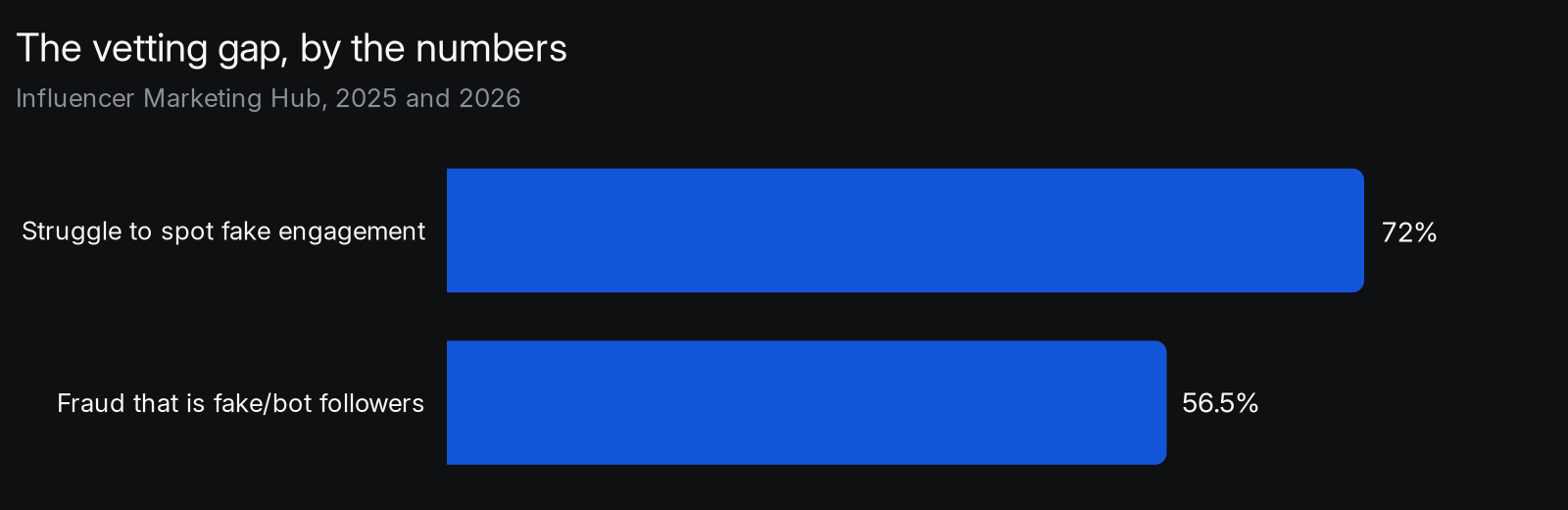
Vetting is where scraped data costs you real money, because raw follower count cannot tell you whether engagement is real, and most brands cannot tell either. 72% of brands report they struggle to identify fake engagement when evaluating creators (Influencer Marketing Hub, 2025), which is exactly why a platform that vets on creator-volunteered, verified data beats one that vets on a scraped follower number.
The downstream cost is not abstract. Brands that skip proper vetting waste an average of $10,000 to $50,000 per failed campaign (industry analysis, 2025), and fake or bot followers are the single largest category of influencer marketing fraud at 56.5% of reported cases (Influencer Marketing Hub, 2026). A platform that pulls verified engagement, audience geography, and real brand-partnership history from a creator who logged in and connected their accounts is vetting against something true. A platform reading scraped public numbers is vetting against whatever the creator’s bio claimed the day it was crawled.
When you evaluate a platform’s vetting, the real test is what it is checking against. Verified first-party signals or a scraped number that nobody confirmed.
Pricing Transparency Tells You Who the Tool Was Built For
Hidden, enterprise-only pricing is itself a signal that a platform was built for F500 buyers, not for you, and the numbers in this category are steep enough to lock most brands out. CreatorIQ pricing runs from $35,000 to $200,000 (Vendr, 2025), and GRIN annual contracts run $25,000 to $200,000-plus (Vendr, 2025), the kind of spend that forces a small team to trade a headcount for a tool.
That trade-off is real and named. Paula Dhier, VP Marketing at Urban Legend Agency, put it plainly: “The alternative search and discovery tools in the market cost a staggering $28k a year, and they lack the essential features we need. Investing in one of those CRMs would mean letting a team member go which is simply impractical for us.”
The honest read on the category is that pricing transparency correlates with audience. Enterprise CRMs hide pricing behind a sales call because the number only works for enterprise budgets. Self-serve tools publish a monthly price because they were built for the mid-market and small brands that 66.3% of brands who run programs in-house actually represent (Influencer Marketing Hub, 2025). When a platform will not show you a price until you book a demo, it is telling you who it was designed to serve.
How the Influencer Marketing Platforms Stack Up
5 platforms answer the same discovery decision in structurally different ways, and the split that matters most is whether the underlying data is scraped from public profiles or volunteered by creators who logged in. The table below compares each option on data source, who the tool is built for, published pricing, and what you actually walk away with.
| Platform | Data source | Built for | Published pricing | What you get |
|---|---|---|---|---|
| Creatorland (MCP) | First-party, OAuth-verified by creators | Creators first, brands query the same layer | $199/mo pilot (early-adopter) | Live discovery, fair-rate intel, verified profiles |
| CreatorIQ | Scraped public profiles, ~20M | Enterprise brands and agencies | $35,000 to $200,000/yr (Vendr, 2025) | Filter search, brand-safety, payments |
| GRIN | Scraped + authenticated, varies | Mid-market and DTC ecommerce | $25,000 to $200,000+/yr (Vendr, 2025) | Creator CRM, gifting, affiliate hub |
| Aspire | Scraped + inbound marketplace, 1M+ | Mid-to-large ecommerce | Custom, not public | Discovery, nurture, campaign management |
| Modash | Scraped public profiles, 350M+ | SMB to mid-market | $199 to $499/mo (Modash, 2026) | Discovery only, no payments |
Row one is the structural outlier: it is the only option where the creators put their own data in and keep it current. Every other row is a brand-first tool reading a scraped index, which is the choice that decides what you find, what you pay, and whether you trust the numbers.
Frequently Asked Questions
How much should a mid-market brand actually pay for a creator platform?
Most mid-market brands are priced out of enterprise CRMs, which run $25,000 to $200,000-plus a year (Vendr, 2025), and end up on self-serve tools in the $199 to $499 per month range. The right number depends on whether you need verified first-party data or are willing to vet scraped records yourself.
Why do two platforms with millions of creators return such different results?
Database size is not the variable that matters; data freshness and source are. A scraped 20-million-profile index can return more irrelevant results than a smaller first-party pool, because scraped records go stale the moment they are captured and the creator has no reason to update them.
Can I trust follower and engagement numbers from a scraped database?
Not reliably. 72% of brands struggle to identify fake engagement (Influencer Marketing Hub, 2025), and fake or bot followers make up 56.5% of reported influencer fraud (Influencer Marketing Hub, 2026). Verified, OAuth-connected data is the only way to vet against something the creator actually confirmed.
What does “first-party creator data” mean in practice?
It means the creator logged in, connected their Instagram, TikTok, or YouTube accounts, and controls their own profile, so the follower counts, engagement, and brand-partnership history are volunteered rather than scraped. The practical effect is a record that stays current because the creator’s career depends on it.
Is an enterprise CRM overkill for a small creator program?
Usually, yes. 66.3% of brands run their programs entirely in-house (Influencer Marketing Hub, 2025), and a six-figure contract often means trading a team member for a tool. A self-serve or AI-data layer gives a small team most of the sourcing value without the enterprise commitment.
How do I plug creator data into the AI tools my team already uses?
Look for a platform with an MCP (Model Context Protocol) server, which lets your team query a creator data layer from inside Claude, Cursor, or Perplexity. Creatorland’s MCP exposes direct tool calls for creator lookup, brief-based search, and fair-rate benchmarking against real closed deals.
What is the biggest mistake brands make when choosing a platform?
Choosing on database size or feature count instead of data source. The single decision that shapes discovery quality, vetting accuracy, and data freshness is whether the records are scraped or creator-volunteered, and most platforms are built brand-first on scraped data.
How Creatorland’s MCP Queries 2.6M Creators on First-Party Data
The whole point of this piece is that data source decides everything downstream, and Creatorland is the one platform in the comparison built creator-first, where the records are OAuth-verified and the creators have a stake in keeping them accurate. The Creatorland Data MCP queries a discovery pool of over 2.6 million creators, 800K-plus indexed posts, and a brand catalog with thousands of canonical creator-brand affiliations, all on first-party data with built-in privacy guarantees against individual-record reconstruction.
It plugs straight into the AI tools your team already runs. From inside Claude, Cursor, Perplexity, or any agent harness, your marketers call search-creators for a brief-based or lookalike shortlist, get-creator-profile for a unified verified lookup, and query-market-intelligence for p25, median, and p75 rate bands derived from real closed deals. That last one is the fair-rate layer the enterprise CRMs cannot match, because they never captured who actually worked with whom at what price.
The pricing is honest about stage and built for brands of every size, not just F500: pilot pricing runs $199 a month, with an early-adopter program through Summer 2026 at 50% off and dedicated onboarding. It is the inverse of a six-figure contract that asks you to trade a headcount for access to a scraped index.